The CofE is to have women bishops, or 'bishops' as they'll now be known. Leaving aside the tenuous link between current practice and the actual role of a bishop in the Bible, there's bound to be a flood of 'who'll be the first one?' blogs and articles.
I've already given my suggestions for Archbishop of Canterbury after Rowan Williams stepped down, which were roundly ignored, but undeterred.....
Teresa May: plenty of experience with public school/Oxbridge educated colleagues, so no problems with the House of Bishops. Won a personal battle with Michael Gove in the cabinet, so the church school and Guardian-reading constituency is sewn up.
Clara Oswald: has spent most of the last year trying to deal with a crotchety old man with limited social skills. Don't worry, there are plenty more out there and they'll start writing to you in longhand from about your 3rd week onwards.
Tess Daly: plenty of experience trying to make discouraged adults feel better after they've spent all week preparing, and given their all in front of a room full of people, only to get harsh comments from folk who sit in the same seats week after week, and watch but never do anything.
Emma Watson: sooner or later there's bound to be a 'she only got the job because she's young and pretty' so lets just get it out the way now. After all, who cares that she's talented and intelligent?
Tinky Winky: purple, carries a handbag, and wears a three-cornered bit of headgear which is clearly a prototype mitre. Subliminal advertising for women bishops which has clearly played a major part in todays vote.
Fiona Bruce: carries a suitable air of authority and can hit a moving parishioner with an arched eyebrow at 60 paces. Good CV: Crimewatch for minor infringements of canon law, Call My Bluff for dealing with Reform and other lobby groups, and Antiques Roadshow for pretty much everything else.
Olivia Colman: already knows the CofE inside out from being a vicars wife in Rev., and now heads up something called Broad Church, a community of people with troubled histories who are struggling to get on with each other. Hang on, has she been consecrated already?
any more suggestions?
Showing posts with label women bishops. Show all posts
Showing posts with label women bishops. Show all posts
Monday, November 17, 2014


Tuesday, July 15, 2014
Women Bishops: The Morning After
Do you ever have those chats where the other person takes ages to get round to what they wanted to say in the first place? It's felt a bit like that as a vicar in the CofE over the last few years - we were going to get round to having women bishops (or 'bishops' as they're now called) eventually, but by 'eck it's taken a long time.
Self-indulgently long in fact.
I tweeted a couple of things on the #synod hashtag yesterday, which got 75 retweets/favourites between them, so must have struck a chord:
"Looking forward to the day when 85 people want to speak at #synod about evangelism" (85 people had indicated that they wanted to speak in the debate)
"Well done #synod, good call. Now back to that tedious old stuff about making disciples of all nations."
It's scandalous that we have taken up so much time, energy and angst over this - yes it's an important issue, but I don't see people queueing up to talk at General Synod about the main thing Jesus set the church up for in the first place, to make disciples of all nations (involving baptising new believers and teaching them the ways of Jesus). It doesn't matter whether a man, a woman or a goat is dressed in a purple shirt if we are not actually making disciples. Yes lets get this right, but lets also remember that it's not the main thing.
Alongside this - and this is where I get thrown out of the CofE completely - is whether we really understand what a bishop is in the first place. The CofE claims to have a 'threefold order of bishops, priests, and deacons'. It doesn't of course, it only has a twofold order of bishops and priests, Deacons used to be a holding pattern for women who were called to the priesthood but not allowed to go there by the church. Now it's something that priests do for a year before, through an episcopally-applied software upgrade, they're then allowed to bless people and run a church (I simplify, of course...).
Several dioceses don't have permanent deacons: people who have a call to be a deacon in the church, and have been ordained specifically to that role. Which makes a bit of a nonsense of the 'threefold order' claim. In the meantime we take a word used for a member of the team leadership of a local church in the NT (overseer/episkopoi) and freight it with 2000 years worth of historical and theological baggage. The God and Politics blog summarises the early part of that history. It's always seemed a bit odd for evangelicals to be debating who should or shouldn't be a bishop, when our understanding and practice has such a slim biblical basis in the first place.
But then, perhaps that's what God intended. The first batch of deacons hardly stuck to the job description: they were supposed to oversee the distribution of food, but we know of one who became a travelling evangelist (Philip) and another (Stephen) got himself killed after doing lots of miracles culminating in a showdown with the authorities. The labels and roles matter less than the authorisation, and the priority, in everything, to get the word out.
In all this there are positive signs - the national priorities of the CofE now include growing the church, and reshaping ministry, so there are signs we're alive to the issues above.
Final point: in the inevitable 'who will the first woman bishop be?' over the coming months, lets keep coming back not to the personalities or the politics, but to the mission of the church. Because if we aren't doing what Jesus set us up to do, then we are not truly the church. Female or male, I'm not that fussed who we have in leadership in the CofE as long as they have the same priorities as Jesus.
Thursday, September 12, 2013
Always a Woman: A Song for the Church of Wales
To celebrate the decision of the Church of Wales to have women bishops, here's one of the moments I remember most vividly from theological college in the 90s. St. Johns Nottingham was a bit of a hotbed of feminism at the time, and my good chum Simon penned this little ditty. Billy Joel as you've never heard him before. I'm not sure how he escaped with his life, to be honest.
Enjoy, if you can.....
Enjoy, if you can.....
Wednesday, December 19, 2012
CofE press office overdrive - burying bishops expenses?
There's an end of term torrent of press releases from the Church of England media centre, including a response to the latest Energy Bill from the government. Each of the other ones is noteworthy, for different reasons:
The House of Bishops has recognised that it needs a bit of outside assistance in drafting decent women bishops legislation for the July synod. I'm glad it's also resisted the calls of WATCH to delay until after the next set of Synod elections (another 3 years), which seems a bizarre request designed to prolong the discomfort in the short term and steamroller traditionalists in the long term. A new working group will start meeting in January to help get something workable together. IIt's a mixture of men and women, lay and ordained, including the lay theologian Paula Gooder and Philip Giddings, current chair of the house of laity at General Synod...
.... though he may not be for much longer. A 'public meeting' of the House of Laity has been called for January, with one item on the agenda. That item is a motion of no confidence in Dr Giddings as chair of the house of laity, citing his speech at the November debate as the reason. I don't know if this legally has to be a public meeting, but I can't really see why it shouldn't happen behind closed doors. There's a danger of it becoming a public trial, and yet another public airing of divisive views. (update, Peter Ould isn't impressed with the reasoning for the motion)
Finally the 2011 figures for Bishops Office and Working costs have been published. These amounted to £17m, a jump of over £1m on last year, most of which is accounted for by increased legal fees. The reason for this (reading between the lines) is the additional cost of the Clergy Discipline Measure, as legal advice for this isn't already covered by the other legal expenses of a Diocese. Full details are here, where you can see what's happened in your own Diocese. Here in Bath and Wells, costs have jumped 10%, whilst next door in Bristol they've gone down. I'm assuming there's a back story to places like Southwark, where costs have risen 40% in a year.
More concerning is the fact that, in 2006, this figure was £11.3m. That's a 50% rise in 5 years. How is budgetary control exercised here? As a local priest, every day I meet the people who pay the bills, and am part of a church that has to balance the books month by month, year by year. That's a big incentive to make sure I use resources wisely. No such financial discipline exists for bishops, the money does not run out, there is not the same context to provide that accountability and discipline. And whilst clergy numbers have dropped significantly in 5 years, we still have 113, the same number, in the purple.
There is mention in the full details of a new 'block grant' system of allocating funds for bishops expenses. Will that mean that, in future, if all the money is spent then there's no more? This will increase by 4% year on year, which is significantly ahead of inflation, and this seems overly generous given the huge increases of recent years.
I'm sure there are local factors wherever these expenses have risen, but the aggregate of 44 local factors over 5 years points to a lack of budgetary control and accountability. Perhaps bishops should be funded out of their dioceses, with budgets accountable to diocesan synods as they are for the rest of diocesan functions? The changes may be an attempt to address the spiralling costs, but the document doesn't mention them, instead the reasoning is 'greater flexibility' for bishops. There already seems to be too much flexibility in the bottom line.
Saturday, November 24, 2012
Women Bishops: the Dave Walker Plan
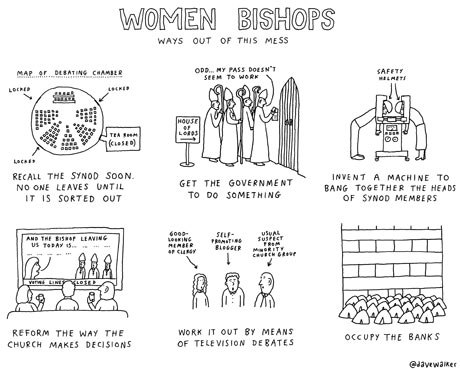
Dave Walker, as reported in the Guardian.
For an even less serious angle, 10 reasons why men should not be ordained.
If you need something more theological, this is pretty good. Rachel Marszalek considers the arguments put forward at Synod for rejecting the measure. You'll need a few minutes to read that one too.
Tina, a pioneer ministry in the north of my diocese, has written an 'elegy for the light spectrum', which is great.
The Ugley Vicar has drafted a 'parish magazine' article trying to explain what went wrong. It's from the conservative standpoint, but it does highlight how almost impossible it's been to find a form of words which commands enough of a majority.
My guess is that, if you're a conservative evangelical or traditionalist catholic, the next few months is your only opportunity for finding a suitable settlement. There are suddenly plenty of energised and passionate laity up and down the country who are in favour of women bishops and want to find a way to get onto General Synod to sort this mess out. There are even petitions calling for the entire Synod to step aside now, or for it t be abolished. That might be cathartic but I think General Synod needs to lie in the bed it has made, and take responsibility for sorting this out in the next 6-9 months. If it's left to the 2015-18 Synod, I can't see many Reform candidates being elected that time round.
It would be ironic if traditionalists found themselves looking back on November 2012 as the best provision they could have had. In the meantime Deanery and Diocesan synods can already start clearing their agendas for 2013 for the motions which are going to come before them.
Tuesday, November 20, 2012
Now What?
I assume that from now on, every Reform church will be paying its parish share in full, and there'll be no more talk about opting out from Diocesan structures. No representation without taxation. After the vote today, it would be outrageous for Reform parishes then to opt into and out of church structures as they saw fit. Having played a full part in the legislative process, and hobbled the CofE's witness in the process (check Twitter if you doubt this), to then withold support would be deeply unjust. It would be like kicking someone in the shins, and then fining them for limping.
Had I the key, and were I in the vicinity of Church House, I would lock General Synod in there until they found a way to sort this out. It's clear that some of the processes before today have been badly flawed, so much as I'd like to I can't just blame the lobby groups. (update: a vicar on our local news in Somerset was making the same point - he argued that Synod could have found a motion that would have commanded enough votes, and managed to accomodate people like himself who were opposed.)
In the end it comes down to whether we trust each other. Traditionalists want stronger guarantees, but the stronger the wording is, the more it betrays the fact that Christians don't trust each other to act like Christians, and are resorting to law to regulate their relationship rather than grace. If that's where we've come to, I can't see how those Christians can share communion, or claim to be in fellowship with one another. We belong to the same institution, but how much more is there to it than that?
Monday, November 05, 2012
Blast from the Past: Women Bishops
Partly because I'm slightly troubled by the lack of any proper theological argument in favour of women bishops on the new 'Yes2womenbishops' website (though I can understand why), and partly because it saves me writing anything new, here's my two-penn'orth on women bishops from way back in 2008. My views haven't changed, though I'd be interested to know if those of WATCH have.
Of course, that piece doesn't address whether the impending vote has 'proper provision' for people who can't agree with women bishops. I would hope that the 'proper provision' is the fact that we're all Christians, and can all deal with one another as Christians. If we can't do that, we're stuffed. Any relationship that has to resort to legal solutions to sort out differences is in serious trouble.
(update: link fixed now!)
Thursday, September 13, 2012
Odd Silences
Odd Silence 1: there is normally a rapid response unit at WATCH and Reform (CofE lobby groups) to any statement on women bishops by the Men in Purple. At the time of writing, despite a meeting and press release yesterday there are no press statements by either group. I must say I'm delighted, well done everyone, I've wondered aloud before whether the debate was being taken over by the lobby groups, and whether it might be better if they went quiet and just let people pray and listen to each other. Could this actually be happening? Or is it that, like me, they don't actually know what the latest amendment really means?
(Update: it couldn't last, there is now a statement from WATCH, oddly it's on their Facebook page, though still no sign of it on their website. But nobody should read it, you can make up your own mind without someone else doing it for you)
Odd Silence 2: having kept Gordon Browns 'bigots' comment hanging over his head for the rest of the election campaign, the BBC have gone strangely quiet on Nick Clegg. Not a peep in the Politics section of their website since Tuesdays row, despite a letter of apology to church leaders in the meantime. Ok, he didn't actually say the word, but it could easily have been made into a running story, a 'beleaguered Clegg' ahead of the party conference.
Wednesday, July 11, 2012
What the Bishops Did Next
Just had this from our Diocese:
GENERAL SYNOD VOTE ON WOMEN BISHOPS
Tuesday, 10 July 2012
Dear Colleagues,
You will have heard through the media of the vote at General Synod in York on Monday morning. I wanted to be in touch as quickly as possible to let you know how things stand.
In May, the House of Bishops chose to make two amendments to the legislation that 42 Diocesan Synods had supported. General Synod has decided, after considerable debate, to refer one of the amendments back to the Bishops. It is, in the jargon, para 5(1)(c), which puts into the Measure specific mention of how arrangements can be made for a parish to request alternative Episcopal oversight. It had attracted considerable criticism from supporters of women in the episcopate, although it had been seen as giving some comfort to those opposed, whether traditionalist catholics or conservative evangelicals.
The Press will probably treat this as a fudge and signs of indecision. Having sat through the debates, I think that is unfair. It was quite clear that everyone - including the Archbishop of Canterbury and the Steering Committee - recognised that the amendment had not been subject to sufficient scrutiny and gave rise to serious concerns. There was no prospect that the Measure, as amended, would get the necessary 2/3 majorities in each of the three Houses of Synod as it stood. Had it been voted on, and rejected, then the whole women Bishops legislation would have failed, and it could not be re-introduced until a new Synod meets in 2015.
The timetable now is this. The House of Bishops will meet in September to further revise the Measure. Clause 5(1)(c) will have to be rewritten to avoid the current pitfalls, and the draft Code of Practice will have to be further developed to clarify the arrangements that will be put into place. That revision will be brought to an extra meeting of General Synod, to be held in November.
I hope this will be done in conjunction with the interested parties, rather than by Bishops alone. The Bishops must approach the further revision in a spirit of listening to the various sets of opinions. Exactly how the Measure will be further amended I cannot say, but I believe the leading constituencies in this matter (WATCH, Forward in Faith, and Reform), as well as key individuals, will be using the time to try and ensure the revised version is one that can gain the required majority, while offering the best possible safeguards to those opposed on theological grounds, so that we can move forward towards consecrating the first women Bishops as soon as possible: something that almost everyone now regards as desirable.
I will be meeting with representatives of our women clergy, traditional anglo-catholics and conservative evangelicals over the next few weeks. I will also speak about the situation at Diocesan Synod to be held at Millfield School on Wednesday evening next week.
Please join me in prayer for continued patience and a spirit of discernment among us all.
PS: Archbishop Rowan’s remarks on the situation can be seen on his website at
http://www.archbishopofcanterbury.org/articles.php/2557/archbishop-of-canterbury-at-general-synod-in-york (scroll down the page).
Helpful to know what's going on, the original Bishops amendment might have had a better hearing with some more background like this. A few thoughts:
- I'm concerned that the various pressure groups are being given what looks like priveliged access to the process. Fair enough, they represent 'constituencies', but they also have a life of their own, and a lot of folk in the CofE are not represented by these people. Is General Synod supposed to function as a representative democracy, with individual delegates taking soundings from their own Dioceses, or in this case has it turned more into the House of Commons with whipped 'parties' supporting one line or another, plus a few crossbenchers? I personally wonder whether the time between now and November would be better spent in prayer, rather than rounds of press releases and position statements designed to influence the process and the outcomes.
- I wonder if the trouble started with the motion the Dioceses were asked to consider and report back on: it referred to a Code of Practice which didn't yet exist, and left vague the question of how people who opposed women bishops would be accomodated (or not). So, if you were in favour of women bishops, but also in favour of accomodation for traditionalists, did you vote for the motion or against it?
- As I said earlier this week, there is a deeper problem of lack of trust. A family only needs to resort to law and codes of behaviour if relationships have broken down. Traditionalists fear that WATCH stands for Win And Treat Conservatives Harshly, and that without explicit safeguards they will be simply be marginalised. If most of the parties are spending their time in conference with like-minded people within their lobby groups, and not with one another in an attempt to listen, understand and love, then I can't see the entrenchment slacking off.
Wednesday, May 23, 2012
House of Bishops statement - links roundup and thoughts
The original statement from the CofE, on the House of Bishops 2 amendments to the legislation on women bishops. You might want to read this later, unless you have a PhD in law, theology and English grammar.
A translation of the statement into English by Unshaun Sheep.
Pete Broadbents explanation of what the amendments mean. He also chips in to this comments thread at Thinking Anglicans.
Bishop Alan offers some analysis and comment.
Nancy Wallace doesn't know what to make of it. I suspect she's not the only one.
Thinking Anglicans has the predictable responses from pressure groups Reform ('disappointed') and WATCH ('disappointed'). Forward in Faiths response is more positive and graciously worded, but still slips the 'd-word' in near the end.
Ancient Briton doesn't think much of the WATCH response, and Radical Disciple doesn't think much of Reforms'
Good post from James Ogley, who sees a legalised 'third province' emerging.
Telling Secrets reckons the Queen needs to have a word
Lay Anglicana thinks that a lot will depend, not on the legislation itself, but on the leadership of the next ABofC
Archdruid Eileen rounds up the press coverage, sort of.
update 1: Andrew Brown comment piece for the Guardian.
There's a blow by blow account of the debates within the CofE here, if you're a real anorak and not fed up with the whole thing already.
My thoughts:
1. When one persons discrimination is another persons theological integrity (or vice versa), we're clearly at an impasse. The choice is whether to make this a red line issue, or attempt to stay together. When we tolerated senior bishops who didn't believe in the risen Jesus (who knows, we may still have some), should we have split then? Should we split now? There is no way to express the views of both WATCH and Reform within a single church. So, do we have 2 separate churches, or try to accomodate? Which is more Christian?
2. My brief take on the amendments is that it's an updated version of Resolutions A&B and flying bishops, to accomodate conservative evangelicals. It provides an institutionalised way of rebelling against the 'liberal' leadership of the church - is this a clever CofE response to the sabre rattling from Southwark, or an impossible line to hold?
And by the way, talk of a 'stained glass ceiling' does the supporters of women bishops no good at all. Ordination is not a career, becoming a bishop is not 'promotion'. But if you want to talk about opportunities to serve, gifts to be used in the service of God's kingdom, and the building up of the church, then I'm all ears.
Update 2 (Sun pm): some more links. Archdeacon in the Dales argues that the CofE can't have it both ways, Church Mouse just wishes the powers that be would get on with it and doesn't think the Bishops amendments amount to a great deal. Thinking Anglicans rounds up a few more links. Miranda Threlfall-Holmes wonders what the long term effects will be, and whether 'pick your own episcopacy' will work.
Update 3: perceptive post from John Richardson, in response to Miranda Threlfall-Homes piece, and the sabre-rattling from WATCH.
Update 4: Rachel Hartland and Seeker and Lay Anglicana all worth a look, WATCH aren't the only supporters of women bishops, and it looks as though their more strident response doesn't sum up everyone's position.
Subscribe to:
Posts (Atom)