On Friday our family are doing a 100km sponsored exercise bike ride in support of TEAR Fund, in reponse to the coronavirus crisis and its impact on the developing world. If you'd like to support that, please go here, or you can donate direct via the TEAR Fund website.
Most countries have a much sketchier welfare state than ours - in many places, lockdown means no work, no work means no food or money. It is a choice between infection or starvation. Or it means confinement in a refugee camp or slum where social distancing is all but impossible, and there isn't access to clean water or soap for the basic act of washing hands.
To get some idea of the challenge, have a look at this article:
South Africa, which has one of Africa’s best public health systems, has fewer than 1,000 intensive care unit (ICU) beds, of which 160 are in the private sector, for a population of 56m. In Malawi, there are about 25 ICU beds in public hospitals, serving 17 million people. The main infectious diseases hospital in Zimbabwe’s capital, Harare, has none.
Showing posts with label poverty. Show all posts
Showing posts with label poverty. Show all posts
Monday, April 27, 2020


Monday, December 16, 2019
Robin da Hood
Todays moral maze:
Which is the bigger crime, stealing £50m of jewellery, or having £50m of jewellery in the first place? If the thief gives the loot away to the poor, does that justify his/her actions? If not, why do we consider Robin Hood to be heroic?
The victim lives about 1 1/2 miles away from Grenfell Tower and donated generously at the time of the tragedy, does that have any bearing on this? Or the fact that she has 55 rooms in her house which, as far as anyone is aware, haven't been offered to any of the Grenfell victims? What about all the other people on that street who aren't in the news today but enjoy the same kind of lifestyle? Does the fact that I have a spare room and haven't offered it to the victims either make me a hypocrite? If so, is it only people with absolutely nothing to spare who can question the rich?
Is it acceptable for anyone to have a 'dog spa' in a city where 4000 are sleeping rough?
How much inequality is too much?
Etc.
Which is the bigger crime, stealing £50m of jewellery, or having £50m of jewellery in the first place? If the thief gives the loot away to the poor, does that justify his/her actions? If not, why do we consider Robin Hood to be heroic?
The victim lives about 1 1/2 miles away from Grenfell Tower and donated generously at the time of the tragedy, does that have any bearing on this? Or the fact that she has 55 rooms in her house which, as far as anyone is aware, haven't been offered to any of the Grenfell victims? What about all the other people on that street who aren't in the news today but enjoy the same kind of lifestyle? Does the fact that I have a spare room and haven't offered it to the victims either make me a hypocrite? If so, is it only people with absolutely nothing to spare who can question the rich?
Is it acceptable for anyone to have a 'dog spa' in a city where 4000 are sleeping rough?
How much inequality is too much?
Etc.
Wednesday, March 13, 2019
A good day to bury bad priorities
Today the government is expected to announce continuing benefit freezes and tax cuts. On Friday Comic Relief will be asking us to donate to projects which deal with poverty and financial hardship, homelessness, mental illness, and providing hope and a future for young people.
I wonder if these 2 things are, in any way, related?
If the government is officially outsourcing the welfare state to the charitable sector, I'd rather they came out and said it rather than did it by stealth.
I wonder if these 2 things are, in any way, related?
If the government is officially outsourcing the welfare state to the charitable sector, I'd rather they came out and said it rather than did it by stealth.
Thursday, December 22, 2016
Ministry in Urban Priority parishes - day conference in Taunton 22/2/17
Coming up soon, this looks good:
Mission and evangelism in ‘priority parishes’
Day outline includes
Keynote address - Rt Revd Philip North, Bishop of BurnleyTheological reflection: The story so far - Revd Dr Malcolm Brown, Director of Mission and Public Affairs, Archbishops’ CouncilStories from clergy on the ground - including Tanya Lord (Diocese of Bristol) and Wendy Ruffle (Diocese of Gloucester)‘Jesus Shaped People’ - Revd Andy Delmege (Diocese of Birmingham) on the ‘Jesus Shaped People’ resource, from his perspective as new chair of the National Estate Churches Network
Mission and evangelism in ‘priority parishes’
In March 2016, the Archbishop of York with Bishop Philip North, convened a consultation in York that looked at Church of England’s ministry and evangelism in parishes that had concentrated areas of deprivation. This day conference provides an equivalent for the South West, helping to inform and continue thinking, looking from a perspective of dioceses where ‘priority parishes’ (both urban and rural) are in the minority.
Who is it for?
- Clergy and lay people who work in parishes which have significant areas of deprivation.
- Representatives from diocesan synods, rural deans and lay chairs, diocesan advisers (evangelism, mission, vocation, discipleship)
- Clergy and lay people who work in parishes which have significant areas of deprivation.
- Representatives from diocesan synods, rural deans and lay chairs, diocesan advisers (evangelism, mission, vocation, discipleship)
Day outline includes
Keynote address - Rt Revd Philip North, Bishop of BurnleyTheological reflection: The story so far - Revd Dr Malcolm Brown, Director of Mission and Public Affairs, Archbishops’ CouncilStories from clergy on the ground - including Tanya Lord (Diocese of Bristol) and Wendy Ruffle (Diocese of Gloucester)‘Jesus Shaped People’ - Revd Andy Delmege (Diocese of Birmingham) on the ‘Jesus Shaped People’ resource, from his perspective as new chair of the National Estate Churches Network
Booking and more information here .
Wednesday, May 18, 2016
CofE Deprivation Map of UK, parish by parish

This is very clever, a new interactive map produced by the CofE, which shows the relative deprivation of every parish in the country. This snippet shows Yeovil (the bit with no colour coding to the left of centre is the mysteriously named 'Odcombe Without', which includes Yeovil FC. Committed fans usually feel a high sense of deprivation, but that's another story).
And if you're not CofE, it still gives quite a good idea of how your city/town/area looks. There are various labelling and map display options, including a colour coded dotting system for churches which tells you which are listed Grade 1, unlisted, demolished etc. Click on a specific parish and it gives you the population, and some basic info on age profile, ethnicity, and the percent who said they were 'Christian' at the 2011 census.
This has the potential to be a colossal timewaster for prevaricating clergy, as well as a very useful tool!
Monday, January 11, 2016
Poverty and Life Chances: Camerons Third Way?
"....There are 4 vital, social insights that I believe must anchor our plan for extending life chances.
First, when neuroscience shows us the pivotal importance of the first few years of life in determining the adults we become, we must think much more radically about improving family life and the early years.
Second, when we know the importance not just acquiring knowledge, but also developing character and resilience there can be no let-up in our mission to create an education system that is genuinely fit for the 21st century.
Third, it’s now so clear that social connections and experiences are vitally important in helping people get on.
So when we know about the power of the informal mentors, the mixing of communities, the broadened horizons, the art and culture that adolescents are exposed to, it’s time to build a more level playing field with opportunity for everyone, regardless of their background.
And fourth, when we know that so many of those in poverty have specific, treatable problems such as alcoholism, drug addiction, poor mental health we’ve got to offer the right support, including to those in crisis.
This is what I would call a life cycle approach – one that takes people from their earliest years, through schooling, adolescence and adult life.
And I believe if we take the right action in each of these 4 areas combined, with all we are doing to bring our economy back to health, we can make a significant impact on poverty and on disadvantage in our country."
Once everyone has recovered from David Bowie's death, it might be worth paying a little more attention to another David, the Prime Minister, and his speech today. The remarks above were prefaced by a brief critique of left and right 'solutions' to poverty based on economics. I wouldn't be surprised if most of the speech & strategy was written by the Centre for Social Justice (beware, slow website).
Some of the policy announcements include:
- extension of relationship support
- financial education in schools, expanding a pilot CofE scheme designed to help children develop a positive attitude to saving and a responsible attitude to debt.
- expanding the 'Troubled Families' programme to another 400,000 families
- a stronger focus on parenting skills in early years, incentivising the take up of parenting classes and trying to make it a normal part of becoming a parent: "I believe if we are going to extend life chances in our country, it’s time to begin talking properly about parenting and babies and reinforcing what a huge choice having a child is in the first place, as well as what a big responsibility parents face in getting these early years right." (I remember being stunned that, on a parents ante-natal course lasting several weeks, there was not a single bit of input about parenting skills, it was all about the mechanics of late pregnancy, birth, feeding etc. Ante-natal classes and health visitors have a massive opportunity to support parents and to help us learn good habits very early on. Children are too precious and vulnerable to leave this to chance.)
- a clearer focus on character development in education, alongside the acquisition of knowledge and skills
- expand the National Citizens Service to cover 60% of 16 year olds
- targetted mentoring for those most at risk of dropping out of GCSEs
- the much trailed demolition of ugly housing estates (this is fraught with risk - it will be very easy for this not to serve the people who live there, if the estate is anywhere in or around London then developer can make more money by pricing the poor out of the replacement housing built on the site. Judging by the successive waves of housing built around Yeovil, we are getting worse at building low-crime aesthetically good environments, not better, and building regulations and pressure on housing density are driving this, alongside house prices and affordability)
- mental health: continued promotion of an open culture around talking about mental illness, support for new mothers, mental health units in A&E, waiting targets for severe illness
- funding for more research and programmes to treat addiction
If it's done well, this could be one of the most important things this government does. There's evidence here of more in-depth thinking about the causes of poverty than we've seen before. What's interesting is that it goes further than Labour ever dared, in terms of the state taking on more parenting functions (developing character, mentoring).
The proof will be action, rather than words - mental health spending has fallen under the coalition, and Camerons Conservatives have a poor record on housing policy and the vulnerable. They have a life-threatening blind spot on food banks, and the planned cuts to tax credits would have been a punch in the face to anyone earning below £30,000, though thankfully these were reversed.
Whatever the flaws, this policy at last reckons with one of the big social facts of modern Britain, that the family unit in many places no longer does the job it once did, of transmitting value, values, skills and role models from one generation to the next. We have been avoiding the uncomfortable truths for a while, I hope there can be a new political consensus that we need a mixed economy of social and economic policy to tackle poverty, and some of this new thinking could be vital. But it will count for very little if Cameron continues to dismantle the welfare state.
update: good piece from Tim Montgomerie on what Cameron missed out
Wednesday, October 28, 2015
2011 Census Data - Mapping Your Town/Village/City

Remember the 2011 census? Whatever happened to all that information?
Well here's some of it, a mapping tool for deprivation data, where you can input your postcode and find out how it ranks on crime, employment, incomes for families and older people, living environment, or all deprivation factors combined. Above is the 'multiple deprivation' map for Yeovil - the purple bits are the two most deprived 'output areas' (neighbourhoods to you and me), both in the 10% most deprived areas nationally.
The area of Sheffield where I grew up turns out to be in the 100 least deprived areas nationally (out of over 33,000). So it turns out I'm reight posh.
Monday, October 05, 2015
What the World Eats, Or Doesn't.

This British family spend just over £260 per week on food.
This family in Chad spend about 80p

'Hungry Planet - what the world eats' has 27 snapshots from round the world of a weekly diet for different families. If you've not caught it yet, Hans Roslings superb BBC programme on ending world poverty is still available on Iplayer, and is really worth a look. It combines brilliant presentation of the stats, with simple stories of how well-targeted aid and help could transform lives.
I showed a selection of the Hungry Planet photos to a school harvest assembly today, where we were collecting for the local food bank. One little boy got it straight away: 'why don't we send all this food to Chad?'
Thursday, July 09, 2015
I warn you not to be poor
Does anyone benefit from the budget?
I put in my 'average' family circumstances, age, 2 children etc. to the BBC's budget calculator, and had a play around with some figures
Salary £10,000 lose £1484
Salary £15,000 lose £1182 (this is just roughly what someone working full time on the new 'National Living Wage' would earn, except it's not a living wage)
Salary £25,000 lose £1351
Salary £35,000 better off by £80
Salary £45,000 better off by £141
Salary £55,000 better off by £141
Everyone who benefits from the welcome rise in the minimum wage will be slapped straight back down again by the cuts to tax credits. If you're working 40 hours a week on the minimum wage now (£6.50) you'll earn £13,520 a year. The increased minimum wage raises this to £14,976. 81% of that increase of £1456 wont be seen. That's one heck of a marginal tax rate. Someone earning that level by working part time, at a rate already above £7.20 per hour will simply lose out with no compensating rise in income.
Whilst someone earning over £50k a year could probably find nearly £1500 of savings in their annual budget (cheaper holiday, cancel the Sky subscription, shop around for haircuts), I have no idea how you do that on £10,000 a year.
At the bottom end of the pay scale, this is pretty much a direct swap of pay for tax credits, transferring the financial burden from the state to the employer. Of course the employer has the option to sack the worker, (though the governments welfare assessment programme has been doing its best to duplicate this), which means your annual wage drops to £0. I applaud the attempt to raise the minimum wage to what, by 2020, will be a living wage, but I can't see it happening without a rise in unemployment. Meanwhile for those whose income is just above the higher rate minimum wage, it's just hefty cut to tax credits (though these are still over £6k a year to a couple with 2 children).
If you've a food bank or debt advice charity near you, and you have any spare time or compassion, please ring them up and offer your services. They're going to need you.
I put in my 'average' family circumstances, age, 2 children etc. to the BBC's budget calculator, and had a play around with some figures
Salary £10,000 lose £1484
Salary £15,000 lose £1182 (this is just roughly what someone working full time on the new 'National Living Wage' would earn, except it's not a living wage)
Salary £25,000 lose £1351
Salary £35,000 better off by £80
Salary £45,000 better off by £141
Salary £55,000 better off by £141
Everyone who benefits from the welcome rise in the minimum wage will be slapped straight back down again by the cuts to tax credits. If you're working 40 hours a week on the minimum wage now (£6.50) you'll earn £13,520 a year. The increased minimum wage raises this to £14,976. 81% of that increase of £1456 wont be seen. That's one heck of a marginal tax rate. Someone earning that level by working part time, at a rate already above £7.20 per hour will simply lose out with no compensating rise in income.
Whilst someone earning over £50k a year could probably find nearly £1500 of savings in their annual budget (cheaper holiday, cancel the Sky subscription, shop around for haircuts), I have no idea how you do that on £10,000 a year.
At the bottom end of the pay scale, this is pretty much a direct swap of pay for tax credits, transferring the financial burden from the state to the employer. Of course the employer has the option to sack the worker, (though the governments welfare assessment programme has been doing its best to duplicate this), which means your annual wage drops to £0. I applaud the attempt to raise the minimum wage to what, by 2020, will be a living wage, but I can't see it happening without a rise in unemployment. Meanwhile for those whose income is just above the higher rate minimum wage, it's just hefty cut to tax credits (though these are still over £6k a year to a couple with 2 children).
If you've a food bank or debt advice charity near you, and you have any spare time or compassion, please ring them up and offer your services. They're going to need you.
Saturday, May 23, 2015
Faith & Welfare, Saints and Safety Nets
Review of Greg Smith Faith, Progressive Localism and the Hol(e)y Welfare Safety Net
You wait weeks for a report on faith and welfare and then two come along at once. Actually, there have been plenty, and with the re-election of the Conservatives, I'm sure there'll be many more.
The William Temple Foundation asked me to review Greg Smiths 'Temple Tract' on faith and welfare. Two recent events made it worth the read. The election result was one: though a Labour government would have still faced some of the issues and realities that Smith describes. The other is the recent report from the Cinnamon Trust, highlighting the vast scale of faith-based social action, and encouraging churches and other faith groups to do more in partnership with other agencies, such as local authorities.
It's this relationship between faith groups and local authorities that Smith focuses on. With a track record in ecumenical work in deprived urban areas, and a key role in the Evangelical Alliances research programme, he brings together the findings of EA research with case studies of local partnership working, and the realities of the welfare state in austerity Britain. Whilst the Cinnamon Trust report encourages faith groups to get on and work in partnership with others, Smiths e-book raises some of the issues those faith groups will need to wrestle with.
Snith's main premise is that recent politics and economics have created a new environment for churches and faith groups. Recession has thrown more people into poverty, and austerity has resulted in a thinner 'safety net', with more means testing. Meanwhile the government has raised the profile of localism - in some cases devolving to local councils the responsibility for parts of the welfare system (e.g. emergency grants and financial aid). This gives both a new challenge, and a new opportunity, for faith groups to work in partnership with local authorities in welfare delivery.
The book splits down into several readable short sections:
- An outline of recent changes to welfare since 2010, and the current (frightening) picture of poverty and inequality
- The contribution of faith groups to welfare, with a particular focus on the responses to Evangelical Alliance surveys.
- A brief survey of 'progressive localism' - how a combination of austerity and local devolution is creating space for new partnership between faith groups and local authorities to provide welfare support.
- Case studies of what this looks like in Blackpool and Preston, with an honest survey of the relative strength and levels of co-operation among the churches, and between the churches/faith groups and the local council.
- 'Common values and sticky issues' - highlighting some of the hurdles to faith group and local authority partnership, and two of the ideologies which would challenge that partnership in the first place: neoliberalism (everyone must take individual responsibility, so don't help the 'undeserving poor') and secularism (faith groups have no part in the public sphere).
The e-book is a call for faith groups to work with local authorities in this new environment. However it also recognises that localism can degenerate into a postcode lottery - if more welfare provision is local, then it also becomes more dependent on the quality of local partnerships, personnel and delivery. The case studies highlight how much difference local factors can make to the quality and outcomes of support given by the faith sector.
Smith also points out that most of the time, there are no issues with faith groups being involved. The main exception is ‘only when people of faith feel so committed to their beliefs that they explicitly present them as truth claims, and when the perceive their beliefs as normative or binding on others that there is real difficulty’
Here is his summary of the argument of the paper:
In other words, churches and faith groups both have new opportunities to serve, in partnership with local authorities, and new opportunities to bring the values of faith into the public square.
In the light of the Cinnamon Trust report I found this a useful booklet to read, provocative and challenging. It has a good summary of recent changes to welfare, is well researched and well referenced, and the combination of local case studies with the wider national picture works well. It was helpful to read the warning that discussions of 'the common good' from positions of power and institutional religion don't give voice to the actual experience of those who need, and are falling into (or through) the safety net.
Just a few quibbles - some page numbers with the index at the start would have been handy. I also was trying to work out who it was aimed at - a lot of Evangelical Alliance research was quoted, so parts of the booklet focused specifically on Evangelicals, in compare/contrast mode with other streams of belief and non-belief. But the main argument of the book seems to be directed at 'faith groups', and there's never an attempt to make a biblical or theological argument for evangelicals to be involved in the welfare state. If the audience was Evangelicals, then it needed more theology, and if it was faith groups in general, then the booklet probably needed less about Evangelicals in particular, and more research from other sections of the 'faith sector'.
I also found it a bit hard to follow Smiths definition of 'progressive localism'. I think I know what he was getting at, Progressive does not mean liberal or elitist. Rather it is something more fundamental than that: an attitude of mind or outlook on life that is, ‘outward looking and creates positive affinities between places and social groups negotiating global processes’. The term progressive has been used to emphasise that new alliances between different community and faith groups are not merely defensive, but ‘rather they are expansive in their geographical reach and productive of new relations between places and social groups. Such struggles can reconfigure existing communities around emergent agendas for social justice, participation and tolerance’. Progressive localism would be even less elitist if there was a clear definition of it that didn't rely on so many abstract nouns.
I was also surprised by the big leap in the final sentences to the conclusion that ‘for new times we need to see some fresh thinking. More democratic engagement, and a renewal and transformation of the major institutions of our society' It's not clear either what kind of transformation is required, or which institutions he's referring to. The radical final paragraphs seem to go way beyond the evidence and argument presented in the previous 20 pages, and I wondered if there was another booklets worth of thinking needed to unpack them!
It's the kind of thing I probably wouldn't have read without being asked, but I'm glad I did. It's made me think about what we do here in Yeovil, and that I need to do more to encourage and give a voice to those members of our church who are engaging at the sharp end of this. Many people have no idea of what's going on around the bottom rungs of the social ladder.
I don't know how the Temple Tracts work, but I'd really like to see a response to Smiths arguments from the Centre for Social Justice.
Faith, Progressive Localism and the Hol(e)y Welfare Safety Net is worth a read if you want something more chewy to put the Cinnamon Trust report into context, or for local church leaders involved in partnerships with their local authority, or wondering what that might involve. David Camerons re-election makes it even more relevant, and there are wider issues for the church here not just in provision, but in prophecy - how do we challenge the state when it neglects the most vulnerable, and how do we give a voice to those who are rendered even more vulnerable by a system which is supposed to be helping them.
The church, and faith groups in general, are not in a place where we can happily take welfare provision back from central government and say 'that's fine, we'll carry on where we left off in the 1940s'. The Cameron government is also showing a worrying tendency towards abdication: following the Lansley reforms the Health secretary is no longer responsible for the NHS, academies are devolving and breaking up the education system, and Eric Pickles has just received a knighthood for 5 years of asking local authorities to make bricks without straw, responsibility for more provision yet with fewer resources. I'm glad there's an increasing openness for the state, voluntary and faith sector to work together in supporting the vulnerable, but it's not enough to keep rescuing people from the river, we need to head upstream to find out why they are falling in.
You wait weeks for a report on faith and welfare and then two come along at once. Actually, there have been plenty, and with the re-election of the Conservatives, I'm sure there'll be many more.
The William Temple Foundation asked me to review Greg Smiths 'Temple Tract' on faith and welfare. Two recent events made it worth the read. The election result was one: though a Labour government would have still faced some of the issues and realities that Smith describes. The other is the recent report from the Cinnamon Trust, highlighting the vast scale of faith-based social action, and encouraging churches and other faith groups to do more in partnership with other agencies, such as local authorities.
It's this relationship between faith groups and local authorities that Smith focuses on. With a track record in ecumenical work in deprived urban areas, and a key role in the Evangelical Alliances research programme, he brings together the findings of EA research with case studies of local partnership working, and the realities of the welfare state in austerity Britain. Whilst the Cinnamon Trust report encourages faith groups to get on and work in partnership with others, Smiths e-book raises some of the issues those faith groups will need to wrestle with.
Snith's main premise is that recent politics and economics have created a new environment for churches and faith groups. Recession has thrown more people into poverty, and austerity has resulted in a thinner 'safety net', with more means testing. Meanwhile the government has raised the profile of localism - in some cases devolving to local councils the responsibility for parts of the welfare system (e.g. emergency grants and financial aid). This gives both a new challenge, and a new opportunity, for faith groups to work in partnership with local authorities in welfare delivery.
The book splits down into several readable short sections:
- An outline of recent changes to welfare since 2010, and the current (frightening) picture of poverty and inequality
- The contribution of faith groups to welfare, with a particular focus on the responses to Evangelical Alliance surveys.
- A brief survey of 'progressive localism' - how a combination of austerity and local devolution is creating space for new partnership between faith groups and local authorities to provide welfare support.
- Case studies of what this looks like in Blackpool and Preston, with an honest survey of the relative strength and levels of co-operation among the churches, and between the churches/faith groups and the local council.
- 'Common values and sticky issues' - highlighting some of the hurdles to faith group and local authority partnership, and two of the ideologies which would challenge that partnership in the first place: neoliberalism (everyone must take individual responsibility, so don't help the 'undeserving poor') and secularism (faith groups have no part in the public sphere).
The e-book is a call for faith groups to work with local authorities in this new environment. However it also recognises that localism can degenerate into a postcode lottery - if more welfare provision is local, then it also becomes more dependent on the quality of local partnerships, personnel and delivery. The case studies highlight how much difference local factors can make to the quality and outcomes of support given by the faith sector.
Smith also points out that most of the time, there are no issues with faith groups being involved. The main exception is ‘only when people of faith feel so committed to their beliefs that they explicitly present them as truth claims, and when the perceive their beliefs as normative or binding on others that there is real difficulty’
Here is his summary of the argument of the paper:
I have argued that the growth of poverty and inequality and the
neo-liberal project to roll back the hard fought for protections of citizens
via state welfare, have led to a constructive reaction by churches, people of
faith and others of goodwill, to fill the holes in the welfare safety net. But
a holy safety net on its own is hardly sufficient to meet that need. Where
central government has delegated, or more truthfully abandoned, many of its
responsibilities to local authorities, without providing sufficient resources
for the task, there are opportunities for creative partnerships. And in a
context of post-secular progressive localism there are public spaces in which
values and beliefs can be publicly articulated and where apologetics and
religious dialogue can take place.
In other words, churches and faith groups both have new opportunities to serve, in partnership with local authorities, and new opportunities to bring the values of faith into the public square.
In the light of the Cinnamon Trust report I found this a useful booklet to read, provocative and challenging. It has a good summary of recent changes to welfare, is well researched and well referenced, and the combination of local case studies with the wider national picture works well. It was helpful to read the warning that discussions of 'the common good' from positions of power and institutional religion don't give voice to the actual experience of those who need, and are falling into (or through) the safety net.
Just a few quibbles - some page numbers with the index at the start would have been handy. I also was trying to work out who it was aimed at - a lot of Evangelical Alliance research was quoted, so parts of the booklet focused specifically on Evangelicals, in compare/contrast mode with other streams of belief and non-belief. But the main argument of the book seems to be directed at 'faith groups', and there's never an attempt to make a biblical or theological argument for evangelicals to be involved in the welfare state. If the audience was Evangelicals, then it needed more theology, and if it was faith groups in general, then the booklet probably needed less about Evangelicals in particular, and more research from other sections of the 'faith sector'.
I also found it a bit hard to follow Smiths definition of 'progressive localism'. I think I know what he was getting at, Progressive does not mean liberal or elitist. Rather it is something more fundamental than that: an attitude of mind or outlook on life that is, ‘outward looking and creates positive affinities between places and social groups negotiating global processes’. The term progressive has been used to emphasise that new alliances between different community and faith groups are not merely defensive, but ‘rather they are expansive in their geographical reach and productive of new relations between places and social groups. Such struggles can reconfigure existing communities around emergent agendas for social justice, participation and tolerance’. Progressive localism would be even less elitist if there was a clear definition of it that didn't rely on so many abstract nouns.
I was also surprised by the big leap in the final sentences to the conclusion that ‘for new times we need to see some fresh thinking. More democratic engagement, and a renewal and transformation of the major institutions of our society' It's not clear either what kind of transformation is required, or which institutions he's referring to. The radical final paragraphs seem to go way beyond the evidence and argument presented in the previous 20 pages, and I wondered if there was another booklets worth of thinking needed to unpack them!
It's the kind of thing I probably wouldn't have read without being asked, but I'm glad I did. It's made me think about what we do here in Yeovil, and that I need to do more to encourage and give a voice to those members of our church who are engaging at the sharp end of this. Many people have no idea of what's going on around the bottom rungs of the social ladder.
I don't know how the Temple Tracts work, but I'd really like to see a response to Smiths arguments from the Centre for Social Justice.
Faith, Progressive Localism and the Hol(e)y Welfare Safety Net is worth a read if you want something more chewy to put the Cinnamon Trust report into context, or for local church leaders involved in partnerships with their local authority, or wondering what that might involve. David Camerons re-election makes it even more relevant, and there are wider issues for the church here not just in provision, but in prophecy - how do we challenge the state when it neglects the most vulnerable, and how do we give a voice to those who are rendered even more vulnerable by a system which is supposed to be helping them.
The church, and faith groups in general, are not in a place where we can happily take welfare provision back from central government and say 'that's fine, we'll carry on where we left off in the 1940s'. The Cameron government is also showing a worrying tendency towards abdication: following the Lansley reforms the Health secretary is no longer responsible for the NHS, academies are devolving and breaking up the education system, and Eric Pickles has just received a knighthood for 5 years of asking local authorities to make bricks without straw, responsibility for more provision yet with fewer resources. I'm glad there's an increasing openness for the state, voluntary and faith sector to work together in supporting the vulnerable, but it's not enough to keep rescuing people from the river, we need to head upstream to find out why they are falling in.
Saturday, April 18, 2015
Are 50% of the Unemployed Using a Food Bank?
The Trussell Trust is due to publish figures next week on food bank use in 2014-15. It served over 913,000 people in 2013-14, and as not all food banks are affiliated to the TT, the total number is probably close to a million, if not past it. The new figures are likely to show a rise to over a million for the Trussell Trust alone. (Given that setting up a foodbank through the TT involves a £1500 franchising cost, I wouldn't be surprised if there are plenty of 'independent' food banks. Like this one, which has over 1000 users.)
Locally, the Lords Larder food bank has been going for nearly 25 years. In 2013 it gave out just over 59,000 items to help 3979 people, in 2014 it was over 60,000 items to help 4175 people. So the numbers are still rising in and around Yeovil, but not as steeply as in previous years: 2012-13 saw a 25% increase. Around 2/3 of the people helped are adults, 1/3 are children. Just think about that for a minute - 1/3 of a million children in the UK are relying on food handouts from charities.
It's a sign of the disintegration of the welfare state that food banks exist in such large numbers, and cater for so many people. With unemployment down to 1.84 million, the number of adults using food banks is equivalent to between a third and a half of the unemployment total. The benefit system is supposed to rule out the need to rely on charity handouts. It's great that so many are so generous with time and food, and one of the many blessings of having a church in every community is that it means a collection point in every community, and a reminder to every community of the needs of their neighbours.
Maybe there's a wider debate here: the welfare state is the backstop for people who can't support themselves, and don't have the support of family and friends. We'd all see it as a duty to support family members and close friends, less so to support people we've never met. At the moment the pecking order is, crudely put:
Support self
Support by family and friends
Welfare state
Support by strangers (i.e. charity and voluntary groups)
so food banks are picking up people failed by the welfare system, MIND are picking up people failed by NHS mental health, Shelter are picking up people failed by the housing market and social housing, etc.
Some questions:
1. Is the Big Society an attempt to reverse the bottom two?
2. For Christians, would we want the bottom two reversed anyway? Who is my brothers keeper, me, or the state?
3. I suspect that most of the extra volunteer time in the Conservative manifesto will go on school governors, as Academy governors are now trustees, and carry a lot more financial and legal responsibility, with less support, than the school governors of 5 years ago. But perhaps there's a chance for a discussion of work: not the cracked record of 'hard working families', but how sometimes its a good thing that not all of our hard work is about providing for ourselves, that its good for the soul, and for the stranger, to put in a shift for something that doesn't directly reward you. Altruism.
4. 1 million people helped through food banks is a sign both of the generosity and success of the voluntary sector (a very high proportion are church run), and of the failure of the welfare system. Because if a food bank isn't there for you, where do you go?
5. If you have a local hustings event, ask the candidates if they know how many people use the local food bank, and how much that's risen by since 2010. If they don't know, or don't want to answer, then they probably don't care.
Locally, the Lords Larder food bank has been going for nearly 25 years. In 2013 it gave out just over 59,000 items to help 3979 people, in 2014 it was over 60,000 items to help 4175 people. So the numbers are still rising in and around Yeovil, but not as steeply as in previous years: 2012-13 saw a 25% increase. Around 2/3 of the people helped are adults, 1/3 are children. Just think about that for a minute - 1/3 of a million children in the UK are relying on food handouts from charities.
It's a sign of the disintegration of the welfare state that food banks exist in such large numbers, and cater for so many people. With unemployment down to 1.84 million, the number of adults using food banks is equivalent to between a third and a half of the unemployment total. The benefit system is supposed to rule out the need to rely on charity handouts. It's great that so many are so generous with time and food, and one of the many blessings of having a church in every community is that it means a collection point in every community, and a reminder to every community of the needs of their neighbours.
Maybe there's a wider debate here: the welfare state is the backstop for people who can't support themselves, and don't have the support of family and friends. We'd all see it as a duty to support family members and close friends, less so to support people we've never met. At the moment the pecking order is, crudely put:
Support self
Support by family and friends
Welfare state
Support by strangers (i.e. charity and voluntary groups)
so food banks are picking up people failed by the welfare system, MIND are picking up people failed by NHS mental health, Shelter are picking up people failed by the housing market and social housing, etc.
Some questions:
1. Is the Big Society an attempt to reverse the bottom two?
2. For Christians, would we want the bottom two reversed anyway? Who is my brothers keeper, me, or the state?
3. I suspect that most of the extra volunteer time in the Conservative manifesto will go on school governors, as Academy governors are now trustees, and carry a lot more financial and legal responsibility, with less support, than the school governors of 5 years ago. But perhaps there's a chance for a discussion of work: not the cracked record of 'hard working families', but how sometimes its a good thing that not all of our hard work is about providing for ourselves, that its good for the soul, and for the stranger, to put in a shift for something that doesn't directly reward you. Altruism.
4. 1 million people helped through food banks is a sign both of the generosity and success of the voluntary sector (a very high proportion are church run), and of the failure of the welfare system. Because if a food bank isn't there for you, where do you go?
5. If you have a local hustings event, ask the candidates if they know how many people use the local food bank, and how much that's risen by since 2010. If they don't know, or don't want to answer, then they probably don't care.
Friday, December 12, 2014
Russell Brand visits a food bank, falls in love with a Christian
In a warehouse in a retail park Christians and sixth formers assemble bags of what would rightly be considered “staples” in a kinder world. Tins of food and packets of biscuits and it’s good that we’re near to the “White Cliffs of Dover” because it feels like there’s a war on and the livid coloured packaging goes sepia in my mind as Dame Vera scores the melancholy scene.
The Christians are as Christians are, kind and optimistic. The donations come from ordinary local folk “We get more from the poorer people” says Martin, a quick deputy in a cuddly jumper. “More from Asda shoppers than Waitrose.” As I contemplate cancelling my Ocado (or whatever it’s called) order Chrissy, the lady who runs the scheme says that this year people who received packages previously have now donated themselves. Previous recipients often volunteer an all. Here older folk and the students diligently box off the nosh and I determine to give them and their heartening endeavor a shout out on the show and my writhing, nervous gut begins to settle.
Chrissy explains how the Canterbury Food Bank has brought people together, not just those it feeds but those who volunteer. “It seemed like a good way to worship Christ” she says. Martin, who I am starting to gently fall in love with, observes that supermarkets profit from the enterprise as Food Bank campaigns encourage their customers to spend more there. “Do you think there’s an obligation for the state to feed people?” I ask “or room for a bit more Jesus kicking the money lenders out of the temple type stuff?”
They smile.
....The Britain of the future will be born of alliances between ordinary, self-governing people, organised locally, communicating globally. Built on principles that are found in traditions like Christianity; community, altruism, kindness, love.
from RB's reflections on last nights Question Time.
The Christians are as Christians are, kind and optimistic. The donations come from ordinary local folk “We get more from the poorer people” says Martin, a quick deputy in a cuddly jumper. “More from Asda shoppers than Waitrose.” As I contemplate cancelling my Ocado (or whatever it’s called) order Chrissy, the lady who runs the scheme says that this year people who received packages previously have now donated themselves. Previous recipients often volunteer an all. Here older folk and the students diligently box off the nosh and I determine to give them and their heartening endeavor a shout out on the show and my writhing, nervous gut begins to settle.
Chrissy explains how the Canterbury Food Bank has brought people together, not just those it feeds but those who volunteer. “It seemed like a good way to worship Christ” she says. Martin, who I am starting to gently fall in love with, observes that supermarkets profit from the enterprise as Food Bank campaigns encourage their customers to spend more there. “Do you think there’s an obligation for the state to feed people?” I ask “or room for a bit more Jesus kicking the money lenders out of the temple type stuff?”
They smile.
....The Britain of the future will be born of alliances between ordinary, self-governing people, organised locally, communicating globally. Built on principles that are found in traditions like Christianity; community, altruism, kindness, love.
from RB's reflections on last nights Question Time.
Tuesday, December 09, 2014
32,449% increase in 8 years. Guess what?
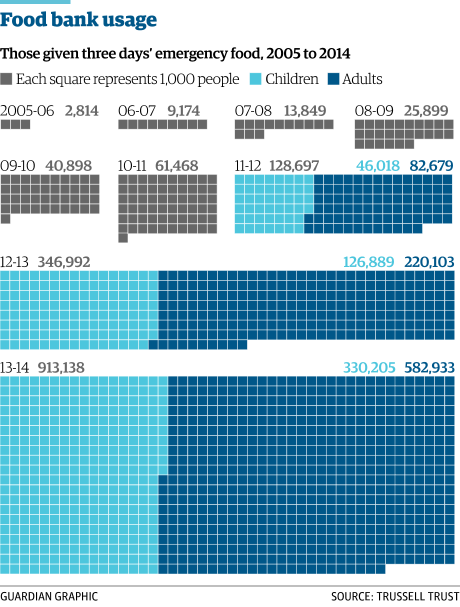
source
update & statistical note: this figure is based only on those fed by Trussell Trust foodbanks. The Trussell Trust was set up in 1999 in Salisbury, and has grown to over 400 centres. There are other food banks (e.g. the Lords Larder here in Yeovil, which has been running since 1991. The 59,000 items they gave out to 3979 people in 2013 was a 25% rise on the year before, and 2014 is running ahead of 2013 in terms of demand. This isn't quite the exponential growth that the Trussell Trust have seen, but any growth is bad. The Feeding Britain report claims that there may be just as many independent food banks as those the Trussell Trust is running.
For example, in Somerset there is also the West Somerset Food Cupboard, though most of the others in the county (Bath, Taunton, Weston, Bridgwater, Somer Valley, Cheddar etc.) are supported by the TT.
Saturday, December 06, 2014
Food Banks: Still a Boom Part of the Economy
The Lords Larder, our local food bank in Yeovil, publishes stats on how many people it helps each year:
2012 - 42,000 items of food to 1986 adults and 1116 children
2013 - 59,000 items of food to 2570 adults and 1409 children
that's a 25% increase in clients, and a 40% increase in food given. Yeovil itself has a population of 45,000 - I think the parcels go further afield than just Yeovil, otherwise we have 10% of the population who are needing food parcels. Bear in mind also that this is the 2013 figure, it would be no surprise if the 2014 figure was even worse. And that's before we've looked at what's coming next.
It's been encouraging to see Yeovil College get involved in supporting them recently, with regular collections of food, and a cash collection at next Thursdays Carol Service. What's more sobering is to think that there are probably lots of college students who are receivers, as well as givers.

Update: major new report coming out on all this Monday, which the Archbishop of Canterbury has thrown his weight behind. Sounds like it will be calling for more food banks, turning Make Lunch into an official part of the welfare state, and getting more 'waste' food used rather than binned.
update 2, and here it is, Feeding Britain
2012 - 42,000 items of food to 1986 adults and 1116 children
2013 - 59,000 items of food to 2570 adults and 1409 children
that's a 25% increase in clients, and a 40% increase in food given. Yeovil itself has a population of 45,000 - I think the parcels go further afield than just Yeovil, otherwise we have 10% of the population who are needing food parcels. Bear in mind also that this is the 2013 figure, it would be no surprise if the 2014 figure was even worse. And that's before we've looked at what's coming next.
It's been encouraging to see Yeovil College get involved in supporting them recently, with regular collections of food, and a cash collection at next Thursdays Carol Service. What's more sobering is to think that there are probably lots of college students who are receivers, as well as givers.
Update: major new report coming out on all this Monday, which the Archbishop of Canterbury has thrown his weight behind. Sounds like it will be calling for more food banks, turning Make Lunch into an official part of the welfare state, and getting more 'waste' food used rather than binned.
update 2, and here it is, Feeding Britain
Wednesday, November 19, 2014
Why do people use Food Banks?
A new report jointly published by Oxfam, the CofE, the Trussell Trust and Child Poverty Action Group busts some of the myths about why people use food banks. Some of the findings are very troubling: they point to a welfare state which no longer works as a safety net, relying on charities to plug the holes. We appear to be heading back to pre-Beveridge days. Here's part of the main summary:
Key findings from the research showed:
Most food bank users interviewed spoke of how severe personal financial crises were often the last straw that had brought them there, only turning to food banks as a last resort when other coping strategies had failed. Deciding to accept help from a food bank was frequently described as 'embarrassing' and 'shameful' but users reported that they would have been completely bereft without it. Considerable personal strength and dignity was also shown by participants, with many displaying great resilience in spite of their circumstances.
The research showed that the very real challenges people face are too often being compounded - rather than assisted - by their experience of the social security system*.
One mum**, who had to give up work to care for her son with serious medical conditions and required intensive support, spoke about her experience when her Child Tax Credits were halved without notice and was horrified by how she was treated. "When our money was stopped, there was no compassion, there was no way to get support," she said, adding "we got behind on all our bills; everything just got swallowed up, and my direct debits were bouncing.
"I thought the system would protect me. I never thought I would be completely ignored. I feel I was let down hugely. My benefits are my safety net - if they're removed, how are families like ours meant to survive?"
The research is based on 40 in depth interviews, and data collected from another 900 users at selected food banks. Over half were there in part because of problems with state benefits.
Food banks vie with gambling as one of the boom areas of the austerity economy. (Remember how we only got hit with that EU levy after drug addiction and prostitution were counted into the GDP figures). It's all pretty depressing. This is where we need our politicians, but it's the charities and the churches who are putting the spotlight on it. Good job we don't stick to our knitting and stay out of politics.
update: links to some of the media coverage of this here, scroll down a little bit.
Key findings from the research showed:
- Food banks were predominantly a last-resort, short-term measure, prompted by an 'acute income crisis' - something which had happened to completely stop or dramatically reduce their income
- Income crisis could be caused by sudden loss of earnings, change in family circumstances or housing problems. However, for between half and two thirds of the users from whom additional data was collected, the immediate trigger for food bank use was linked to problems with benefits (including waiting for benefits to be paid, sanctions, problems with ESA*) or missing tax credits
- Many food bank users were also not made aware of the various crisis payments available in different circumstances, and even fewer were receiving them
- 19-28% of users for whom additional data was collected had recently had household benefits stopped or reduced because of a sanction* and 28-34% were waiting for a benefit claim which had not been decided*
- Many food bank users faced multiple challenges, including ill-health, relationship breakdown, mental health problems or substantial caring responsibilities. Many were unable to work or had recently lost their job. The frequency of bereavement among food bank users was also a striking feature of this research
- Use of emergency food aid in the UK, particularly in the form of food banks, has dramatically increased over the last decade. Figures from The Trussell Trust show that numbers receiving three days' food from their food banks rose from 128,697 in 2011-12 to 913,138 in 2013-14.
Most food bank users interviewed spoke of how severe personal financial crises were often the last straw that had brought them there, only turning to food banks as a last resort when other coping strategies had failed. Deciding to accept help from a food bank was frequently described as 'embarrassing' and 'shameful' but users reported that they would have been completely bereft without it. Considerable personal strength and dignity was also shown by participants, with many displaying great resilience in spite of their circumstances.
The research showed that the very real challenges people face are too often being compounded - rather than assisted - by their experience of the social security system*.
One mum**, who had to give up work to care for her son with serious medical conditions and required intensive support, spoke about her experience when her Child Tax Credits were halved without notice and was horrified by how she was treated. "When our money was stopped, there was no compassion, there was no way to get support," she said, adding "we got behind on all our bills; everything just got swallowed up, and my direct debits were bouncing.
"I thought the system would protect me. I never thought I would be completely ignored. I feel I was let down hugely. My benefits are my safety net - if they're removed, how are families like ours meant to survive?"
The research is based on 40 in depth interviews, and data collected from another 900 users at selected food banks. Over half were there in part because of problems with state benefits.
Food banks vie with gambling as one of the boom areas of the austerity economy. (Remember how we only got hit with that EU levy after drug addiction and prostitution were counted into the GDP figures). It's all pretty depressing. This is where we need our politicians, but it's the charities and the churches who are putting the spotlight on it. Good job we don't stick to our knitting and stay out of politics.
update: links to some of the media coverage of this here, scroll down a little bit.
Saturday, October 04, 2014
Andy Hawthorne/Stephen Nolan interview: an inspiring 26 minutes of radio
If you've not heard Stephen Nolans recent 5 Live interview with Andy Hawthorne of the Message trust, then listen to it here. Brilliant. Nolan isn't a Christian by any definition, but he's clearly struck by both Andy's story, and who he is:
"There's something thats kind of drawing me to the expression on your face, you've got this radiance about you, this exuberance, this happiness about you, I'm just intrigued as to what this is all about..."
"Even if (you're deluding yourself) you're getting a contentment and joy that non-believers don't have."
"I've desperately wanted to believe in God for a very long time, but I don't want to bluff myself."
Hawthorne is completely up front about his faith, and I would love to be 30 years into ministry and still have the passion and enthusiasm that he's got.
"There's something thats kind of drawing me to the expression on your face, you've got this radiance about you, this exuberance, this happiness about you, I'm just intrigued as to what this is all about..."
"Even if (you're deluding yourself) you're getting a contentment and joy that non-believers don't have."
"I've desperately wanted to believe in God for a very long time, but I don't want to bluff myself."
Hawthorne is completely up front about his faith, and I would love to be 30 years into ministry and still have the passion and enthusiasm that he's got.
Wednesday, September 24, 2014
How to Busk Properly
Bath Abbey has been having problems with unruly buskers, whose amplified warblings are drowning out worship services. Busking is a major part of Bath city centre life, and the Abbey has a good working relationship with most of the regulars. It's a different story, when they use battery-powered amps outside the doors whilst a funeral service is going on inside.
Here is a better way to busk. Ht Banksyboy. And not an amp in sight.
Here is a better way to busk. Ht Banksyboy. And not an amp in sight.
Saturday, February 22, 2014
Food Bank Britain & the Bishops
Good piece in the Guardian yesterday by Jonathan Freedland in response to the discussion prompted by the bishops intervention on welfare cuts earlier this week:
there has been something of a delayed reaction to the rise and rise of genuine hunger in this country. The unkind would call it denial. But it is becoming harder to deny.
This week the nation's most senior clerics told of what they are seeing every day, in the parishes where they and their colleagues live and work. Vincent Nichols, the newly elevated Catholic cardinal, branded the way the welfare system functions "a disgrace", while 27 Anglican bishops and 16 other Christian leaders blamed the government's benefits changes for a "national crisis" of hunger.
Predictably the coalition's defenders told the men of the cloth to back off, telling them they had no business poking their nose into such matters and should stick to "religion". Apparently they interpret the old Alastair Campbell dictum that politicians shouldn't do God to mean that God shouldn't do politics.
Perhaps they think churches exist to tidy up the hymn books and keep flowers in the vestry. In fact, the major faiths see their mission as nothing less than healing the world. So of course if they see people going hungry, they cry out. It is their duty.
It's their right too. Few institutions in our national life are doing more to deal with the return of a problem some might have thought we banished after the Depression, if not the Victorian age. Where do you think many of the more than 400 food banks run by the Trussell Trust operate? In church halls....
The Telegraph takes a different tack, pointing to a survey last year that showed that the 'majority' of Anglicans thought the welfare budget too high, and that it should be cut.
2 brief points for Telegraph readers:
a) Thinking that the welfare budget is too high is not the same as wanting people to be destitute. I'd probably agree that the welfare budget is too high, but there must be ways to tackle it that don't force people to choose between heating and eating.
b) 83% of the Anglicans in the survey aren't active members of any church. Describing yourself as an Anglican isn't the same as being an active, worshipping member of an Anglican church. The Telegraph fails to mention this.
Maybe they're miffed that the bishops wrote to a left wing rag like the Mirror, if their coverage of the story is anything to go by.
Monday, December 09, 2013
The Foodbank

Latest cartoon in Dave Walkers current Advent series. Puts me in mind of a line from a church urban fund chap (can't remember his name), that's it's all very well pulling people out of the river, but we also need to ask why people are falling in in the first place.
Saturday, November 30, 2013
Cause/Effect
“The Church's task is not just to pull people out of the river, but to
go upstream and ask who or what is throwing them in in the first place”
(Niall Cooper, Church Action on Poverty)
Subscribe to:
Posts (Atom)