Monday, June 23, 2014
Beyonce 'where you lead me Lord, I will go'
I don't know what was more of a surprise, Beyonce in a Gospel song alongside fellow Destinys Child singers Michelle Williams and Kelly Rowland, or the fact that she's almost dressed modestly. I must admit I don't quite get the US music scene (and don't follow it that closely), with artists publicly tweeting their Christian faith one week then doing something daft a week later.
But anyway, good uplifting song for a Monday, and nice to watch a pop video that I don't have to shield my children from.


Wednesday, June 18, 2014
Justin Welby at Parliamentary Prayer Breakfast
An inspiring, challenging and encouraging talk 'the global church in the 21st century' by the AB of C at the Parliamentary Prayer Breakfast earlier this week. The full text is here, video here, below are some snippets which jumped out at me:
 whatever else the Church is, I hope and pray and we will never just be useful – what a dreadful condemnation that would be. There have been moments when we’ve fallen into that trap, and the walls of Lambeth Palace are lined with Archbishops looking useful [laughter], a bit like Hogwarts. But it’s always happened when we’ve lost sight of the fact that at the heart of being a Christian is knowing Jesus Christ, so that together as we meet with Him and share in worship, we find ourselves renewed and strengthened for the call of carrying the cross and following Him.
 "The Church, though, is a suffering church in this century. It is growing and in growing it suffers. It carries a cross. That is as true today as ever, and the last few years have demonstrated the truth and cost of that reality. A couple of weeks ago, Caroline and I were in Lahore in Pakistan.... We met some of the clergy and the Bishop of Peshawar who were involved in the bomb explosion last September at All Saints Church, an Anglican church, in which over 200 people were killed. And you ask them: “How are things recovering? Are people still going to church?” “Oh,” they said. “The congregation has tripled.” It is a suffering church and a church of courage.
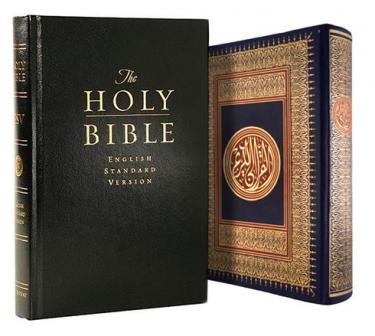 "And lastly we are a hospitable church in the 21st century if we follow Christ – utterly at home in a world of numerous faith traditions. Open about the hope we have while listening to others. In Lent I spent some time with Ibrahim Mogra, the remarkable Muslim leader from Leicester, and we shared together our scriptures: I read bits of John’s Gospel with him, and he read bits of the Qur’an with me. Hospitable. That belonging to one another, being different, diverse and yet authentic to oneself and to one’s tradition and the truth, is a gift this world needs. It’s the opposite of all this Trojan Horse process. It is a generosity of spirit and openness to listen. The 21st century Church knows that the good news of Jesus Christ is a gift which is to be shared in witness.
whatever else the Church is, I hope and pray and we will never just be useful – what a dreadful condemnation that would be. There have been moments when we’ve fallen into that trap, and the walls of Lambeth Palace are lined with Archbishops looking useful [laughter], a bit like Hogwarts. But it’s always happened when we’ve lost sight of the fact that at the heart of being a Christian is knowing Jesus Christ, so that together as we meet with Him and share in worship, we find ourselves renewed and strengthened for the call of carrying the cross and following Him."The Church, though, is a suffering church in this century. It is growing and in growing it suffers. It carries a cross. That is as true today as ever, and the last few years have demonstrated the truth and cost of that reality. A couple of weeks ago, Caroline and I were in Lahore in Pakistan.... We met some of the clergy and the Bishop of Peshawar who were involved in the bomb explosion last September at All Saints Church, an Anglican church, in which over 200 people were killed. And you ask them: “How are things recovering? Are people still going to church?” “Oh,” they said. “The congregation has tripled.” It is a suffering church and a church of courage.
all Christians belong to one another as sister and brother, not as mutual members of a club. Through all our differences of culture... and we belong to one another not because we choose to but because God has made us that way; you can choose your friends, but you’re stuck with your relatives, and I have to tell you that all who follow Christ are relatives, so you’re stuck with me and I’m stuck with you, so we’d better get used to it. And that last point is essential to understanding how we act as the Church in the 21st century. We do not have the option, if we love one another, of simply ditching those with whom we disagree.
In the Church of England we are seeking to start a radical new way of being the Church: good and loving disagreement, a potential gift to a world of bitter and divisive conflict. What can be more radical than to disagree well, not by abandoning principle and truth, but affirming it – agreeing what is right, acting on it and yet continuing to love those who have a different view?
"The poor are not served by a divided church obsessed with inward issues.
even 20 years ago it took months to reach the far corners of the earth now, as we know, take seconds. Instant reaction has replaced reflective comment. That is a reality that you deal with in politics, and it demands a new reality of ways in which we accept one another, love each other, pray for each other. The best answer to a complex issue on which one has heard a soundbite from a sophisticated argument is not always given in 140 characters.
"International aid. The Church of the 21st century is among the most efficient and the best deliverers of help for the poor that exists on the face of the earth... Isn’t it wonderful, let’s celebrate what’s good – it’s easy to be cynical about politics – but let’s celebrate what’s good: that with cross-party support in this country we have maintained international aid at 0.7 per cent of GDP.
"In the South Sudan, again in January, Caroline and I were there, and we were called a couple of days before we got there by the Archbishop, Daniel Deng, one of the great heroes of the faith, and he said: “Would you come up to Bor with me?” A town in the middle of the fighting zone. Well, we did, with a slight objection from some people, but we did. And we went out and we found the town that had been taken and retaken four times. Bodies on the streets, the smell of death in 40 degrees of heat everywhere. Mass graves to consecrate. And what does Daniel do? He goes on national television in the South Sudan and calls for reconciliation. Isn’t that extraordinary? Doesn’t that speak of what the Church should be? And in Sudan, the Church is also speaking heroically for an imprisoned woman and her two children, Meriam, for whom truth matters enough to die. A 21st-century global church loves the poor and the victim, and stands for human dignity, challenges oppressors and supports victims. It speaks for women killed in lynchings called “honour killings”, or for those imprisoned under blasphemy laws. It does all that despite its own suffering. Truth and love embrace.
"And it’s a forgiven church because it’s a failing church. The Church is always full of failure, and I’m sorry to say that’s because it’s always full of people. Without wishing to be controversial, you’re sinners, and so am I. I once said that in a sermon and someone came up afterwards and said: “I’d never have come and listened to you if I knew you were a sinner.”
"And lastly we are a hospitable church in the 21st century if we follow Christ – utterly at home in a world of numerous faith traditions. Open about the hope we have while listening to others. In Lent I spent some time with Ibrahim Mogra, the remarkable Muslim leader from Leicester, and we shared together our scriptures: I read bits of John’s Gospel with him, and he read bits of the Qur’an with me. Hospitable. That belonging to one another, being different, diverse and yet authentic to oneself and to one’s tradition and the truth, is a gift this world needs. It’s the opposite of all this Trojan Horse process. It is a generosity of spirit and openness to listen. The 21st century Church knows that the good news of Jesus Christ is a gift which is to be shared in witness.
"The church is not an NGO with lots of old buildings. It is the Church of God, rejoicing in the realities of cultural diversity in a way never known before: global, cross-bearing, confident and welcoming. The Church holds for the world the treasure of reconciliation, and offers it as a gift freely given out of its own experience of struggling with the reality of it, of being reconciled ourselves through the sovereign love of God in Jesus Christ. The global Church is above all God's church, for all its failings, and in passionate devotion to him will offer the treasure He puts in our hands, unconditionally, always pointing in worship, deed and word to Jesus Christ.
Sorry, that's a lot of snippets, but there is a lot of good stuff in there. Well worth a read/listen.
Some links to the media coverage of the breakfast here
Tuesday, June 17, 2014

Sunday, June 15, 2014
Desperate news from Iraq
Amidst all the terrible events in Iraq, Andrew White, the vicar of Baghdad, posts this heartbreaking account:

Dear Friends,
Things are so bad now in Iraq, the worst they have ever been. The Islamic terrorists have taken control of the whole of Mosul which is Nineveh the main Christian stronghold. The army have even fled. We urgently need help and support.
Please, please help us in this crisis.
Iraq is now in its worst crisis since the 2003 war. ISIS (the Islamic State of Iraq and Syria Group), a group that does not even see Al Qaida as extreme enough, has moved into Mosul, which is Nineveh. It has totally taken control, destroyed all government departments. Allowed all prisoners out of the prisons. Killed countless numbers of people. There are bodies over the streets. The army and police have fled, so many of the military resources have been captured. Tankers, armed vehicles and even helicopters are now in the hands of ISIS.
Mosul residents fleeing the ISIS takeover.
The area is the heartland of the Christian community. Most of our people come from Nineveh and still see that as their home. It is there that they return to regularly. Many Christian’s fled from back to Nineveh from Baghdad, as things got so bad there. Now the Christian centre of Iraq has been totally ransacked. The tanks are moving into the Christian villages destroying them and causing total carnage. The ISIS militants are now moving towards Kirkuk, major areas to the Oil fields that provide the lifeblood of Iraq. We are faced with total war that all the Iraqi military have now retreated from.
People have fled in their hundreds of thousands to Kurdistan still in Iraq for safety. The Kurds have even closed the border, preventing entry of the masses. The crisis is so huge it is almost impossible to consider what is really happening.....
read it all, and donate to help Christians in Iraq here.
Saturday, June 14, 2014
Wednesday, June 11, 2014
Good Values, Bad Values, No Values?
If, for example, your country has a public health system that ensures that everyone who needs treatment receives it, without payment, it helps instil the belief that it is normal to care for strangers, and abnormal and wrong to neglect them. If you live in a country where people are left to die, this embeds the idea that you have no responsibility towards the poor and weak. The existence of these traits is supported by a vast body of experimental and observational research, of which Labour and the US Democrats appear determined to know nothing.
We are not born with our core values: they are strongly shaped by our social environment. These values can be placed on a spectrum between extrinsic and intrinsic. People towards the intrinsic end have high levels of self-acceptance, strong bonds of intimacy and a powerful desire to help others. People at the other end are drawn to external signifiers, such as fame, financial success and attractiveness. They seek praise and rewards from others.
Research across 70 countries suggests that intrinsic values are strongly associated with an understanding of others, tolerance, appreciation, cooperation and empathy. Those with strong extrinsic values tend to have lower empathy, a stronger attraction towards power, hierarchy and inequality, greater prejudice towards outsiders, and less concern for global justice and the natural world. These clusters exist in opposition to each other: as one set of values strengthens, the other weakens.
They tend to report higher levels of stress, anxiety, anger, envy, dissatisfaction and depression than those at the intrinsic end. Societies in which extrinsic goals are widely adopted are more unequal and uncooperative than those with deep intrinsic values. In one experiment, people with strong extrinsic values who were given a resource to share soon exhausted it (unlike a group with strong intrinsic values), as they all sought to take more than their due.
As extrinsic values are strongly associated with conservative politics, it's in the interests of conservative parties and conservative media to cultivate these values. There are three basic methods. The first is to generate a sense of threat. Experiments reported in the journal Motivation and Emotion suggest that when people feel threatened or insecure, they gravitate towards extrinsic goals. Perceived dangers – such as the threat of crime, terrorism, deficits, inflation or immigration – trigger a short-term survival response, in which you protect your own interests and forget other people's.
do read the whole thing, a really key contribution to the values debate. He makes the excellent point that if taxation if repeatedly portrayed as a burden, people will come to resent it and see it as a bad thing - taxation is one way in which we act as our brother and sisters keeper, one way in which we are bound together as a community and nation.
update: for a different but helpful perspective, try British Values do not Exist, which argues that we should be talking about British institutions (sovereign parliament, rule of law, monarchy etc.). Actually, not that different - the piece above is to some degree about how our institutions work (public health, the rule of law etc.) and how they shape, and are shaped by society. Values don't exist in a vacuum.
(and also see yesterdays post on what sort of values bring the best out of us)
update: for a different but helpful perspective, try British Values do not Exist, which argues that we should be talking about British institutions (sovereign parliament, rule of law, monarchy etc.). Actually, not that different - the piece above is to some degree about how our institutions work (public health, the rule of law etc.) and how they shape, and are shaped by society. Values don't exist in a vacuum.
(and also see yesterdays post on what sort of values bring the best out of us)
Purpose, not profit, brings the best out of us
This is a fascinating video clip, which needs to be shown to everyone in the bankers bonus debate who squawks about the best talent going overseas if we pay them less.
[Ok, I'll sum up, because 95% of you aren't going to click the little 'play' triangle. There's repeated research that rewarding performance with money doesn't work, once you get past paying folk enough for them to stop worrying about money. Incentives work for 'mechanical' tasks (think piecework in a clothes factory), but once a task involves any thinking or creative skill, results get worse the more you reward them. Why? Because there are motivating factors that outweigh money:
- Autonomy (being self-directed, in charge of my own work)
- Mastery (getting better at things)
- Purpose (making a contribution)
Profit motive detached from purpose tends to make for bad work, workplace, products and customer service.]
For church folks out there, the great thing is that we've always had the purpose thing. It's easy to lose it though, and to settle for a lesser purpose = keeping the show on the road, paying the bills, rather than the Kingdom of God.
But what about the other two. Are we giving people the chance to get better at things, do we give folk autonomy - the freedom to fly and the freedom to fail? Autonomy isn't simply leaving people to get on with a job on their own, that's negligence, and there's too much of that in the church. And we have a big battle on our hands, there are still plenty of churches where the default setting on any decision or action is to check it out with the vicar first.
Autonomy doesn't come naturally when people are afraid of making the wrong decision, or don't get encouraged. Gordon Macdonald (I think) tells the story of a young businessman who lost his company lots of money on a deal. He reported to the company boss, expecting to be sacked on the spot. "why would I want to sack you?" said the boss "I've just spent $3m on your education."
And on this issue have a look at this reflection on the 'flashmob wedding' which went viral last year. "What Kate (the vicar) has done here is to give a couple back some ownership of their wedding from a church that has been used to telling people what they want." Our culture takes 'user generated content' for granted, and we have the demanding but inspiring task of leading the dance between ancient forms and user content so that both are energised by the other.
3 challenges for me here, related to these 3 motivators:
- how to get better at properly delegating and encouraging, to foster autonomy without neglect (simply leaving people to their own devices) or nannying (constantly checking up)
- asking people 'what would you like to get better at?' and asking myself the same question. If I spend a lot of time doing something (preaching, leading worship, blogging, organising stuff), then a percentage of that time should go into improving my skills in that area.
- linking what people do to purpose: e.g. how a well hoovered carpet creates a sense of welcome and care for the visitor, that doing the Sunday morning Bible reading is not a slot on a rota but an opportunity to hear the living words of the living God etc. Rotas are a great management tool, but if they are all we have, then don't be surprised if it gets more and more difficult to fill them. People need to know why they're doing this task in the first place.
Tuesday, June 10, 2014
Questions for the CofE to ask itself
Here are some ideas that might be worth thinking about.
- Be realistic. It is what it is; don't try and massage the figures to make them say what they don't. Fewer people means fewer resources, which means less capacity to serve, to transform and to witness.
- Be brave. It will get worse before it gets better. There are a lot of aged saints who are going to be promoted to glory and not many younger ones coming up to replace them. Plan to cope with more decline.
- Be honest. That's not quite the same as being realistic. Don't use rhetoric about being faithful rather than successful to gloss over the situation. Don't talk about the inscrutable purposes of God and how he moves in a mysterious way, and how all over the church seeds of new life are being planted which will bear fruit according to God's perfect timing. Don't talk up the good that is still being done with fewer people. That's not the point.
- Be ruthless... You have 4,800 chapels, and that's too many. Close some, sell the buildings and use the money.
- ...But not too ruthless. Many of these are the only functioning place of worship in the town or village. They might be liabilities at the moment, but they could be assets. Develop a strategy to support and revive them.
- Don't lose your nerve. There is a huge amount about the church for non-members to admire. In your political and social awareness, your sense of the breadth and scope of the Gospel and your willingness to put serious money into transforming society, you leave other denominations standing. Be confident in who you are; don't imagine that if you can just ape what other Churches do the problem will go away.
- Don't beat yourselves up too much. Your churches are lovely (mostly) and your ministers are capable.
- Be deeply, painfully self-critical. The hardest thing we can ever do is critique who and what we are, because it means standing outside the frame of reference which we've always taken for granted. But the Church has the opportunity to ask itself really hard questions about how it expresses the Gospel and embodies the Kingdom in the 21st century, and about whether it has enough of an evangelistic drive to survive - not, as its general secretary also says, for the sake of the survival of the institution, but because "the best thing that anyone can do, whoever they are, wherever they live, at whatever time and in whatever circumstances, is to become a disciple of Jesus Christ. And consequently seeking and finding apt, relevant, sensitive and effective ways of presenting Jesus Christ to the world in which we live with so many and so different others is the critical task of the Church today."
I've deliberately taken out references (well, most of them) that would identify the denomination, but you'll find out here.
Even though these are about a different denomination, I think it's all stuff that the Church of England needs to think about long and hard.
update: here is my rather more long-winded attempt to pose some of the CofE issues.
update 2: some discussion of this post in this thread at Thinking Anglicans, though it's intermingled with some other stuff. If you know TA, you won't be surprised to learn that the other topic of debate is to do with sex.
update: here is my rather more long-winded attempt to pose some of the CofE issues.
update 2: some discussion of this post in this thread at Thinking Anglicans, though it's intermingled with some other stuff. If you know TA, you won't be surprised to learn that the other topic of debate is to do with sex.
Subscribe to:
Posts (Atom)