Showing posts with label 'persecution'. Show all posts

Wednesday, June 18, 2014

Justin Welby at Parliamentary Prayer Breakfast

An inspiring, challenging and encouraging talk 'the global church in the 21st century' by the AB of C at the Parliamentary Prayer Breakfast earlier this week. The full text is here, video here, below are some snippets which jumped out at me:

whatever else the Church is, I hope and pray and we will never just be useful – what a dreadful condemnation that would be. There have been moments when we’ve fallen into that trap, and the walls of Lambeth Palace are lined with Archbishops looking useful [laughter], a bit like Hogwarts. But it’s always happened when we’ve lost sight of the fact that at the heart of being a Christian is knowing Jesus Christ, so that together as we meet with Him and share in worship, we find ourselves renewed and strengthened for the call of carrying the cross and following Him.


"The Church, though, is a suffering church in this century. It is growing and in growing it suffers. It carries a cross. That is as true today as ever, and the last few years have demonstrated the truth and cost of that reality. A couple of weeks ago, Caroline and I were in Lahore in Pakistan....  We met some of the clergy and the Bishop of Peshawar who were involved in the bomb explosion last September at All Saints Church, an Anglican church, in which over 200 people were killed. And you ask them: “How are things recovering? Are people still going to church?” “Oh,” they said. “The congregation has tripled.” It is a suffering church and a church of courage.


all Christians belong to one another as sister and brother, not as mutual members of a club. Through all our differences of culture... and we belong to one another not because we choose to but because God has made us that way; you can choose your friends, but you’re stuck with your relatives, and I have to tell you that all who follow Christ are relatives, so you’re stuck with me and I’m stuck with you, so we’d better get used to it.  And that last point is essential to understanding how we act as the Church in the 21st century. We do not have the option, if we love one another, of simply ditching those with whom we disagree. 

In the Church of England we are seeking to start a radical new way of being the Church: good and loving disagreement, a potential gift to a world of bitter and divisive conflict. What can be more radical than to disagree well, not by abandoning principle and truth, but affirming it – agreeing what is right, acting on it and yet continuing to love those who have a different view?

"The poor are not served by a divided church obsessed with inward issues.

even 20 years ago it took months to reach the far corners of the earth now, as we know, take seconds. Instant reaction has replaced reflective comment. That is a reality that you deal with in politics, and it demands a new reality of ways in which we accept one another, love each other, pray for each other. The best answer to a complex issue on which one has heard a soundbite from a sophisticated argument is not always given in 140 characters.

"International aid. The Church of the 21st century is among the most efficient and the best deliverers of help for the poor that exists on the face of the earth... Isn’t it wonderful, let’s celebrate what’s good – it’s easy to be cynical about politics – but let’s celebrate what’s good: that with cross-party support in this country we have maintained international aid at 0.7 per cent of GDP.

"In the South Sudan, again in January, Caroline and I were there, and we were called a couple of days before we got there by the Archbishop, Daniel Deng, one of the great heroes of the faith, and he said: “Would you come up to Bor with me?” A town in the middle of the fighting zone. Well, we did, with a slight objection from some people, but we did. And we went out and we found the town that had been taken and retaken four times. Bodies on the streets, the smell of death in 40 degrees of heat everywhere. Mass graves to consecrate. And what does Daniel do? He goes on national television in the South Sudan and calls for reconciliation. Isn’t that extraordinary? Doesn’t that speak of what the Church should be? And in Sudan, the Church is also speaking heroically for an imprisoned woman and her two children, Meriam, for whom truth matters enough to die. A 21st-century global church loves the poor and the victim, and stands for human dignity, challenges oppressors and supports victims. It speaks for women killed in lynchings called “honour killings”, or for those imprisoned under blasphemy laws. It does all that despite its own suffering. Truth and love embrace.

"And it’s a forgiven church because it’s a failing church. The Church is always full of failure, and I’m sorry to say that’s because it’s always full of people. Without wishing to be controversial, you’re sinners, and so am I. I once said that in a sermon and someone came up afterwards and said: “I’d never have come and listened to you if I knew you were a sinner.”
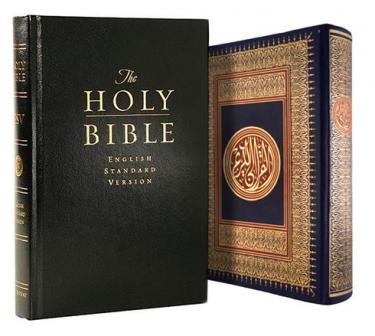
"And lastly we are a hospitable church in the 21st century if we follow Christ – utterly at home in a world of numerous faith traditions. Open about the hope we have while listening to others. In Lent I spent some time with Ibrahim Mogra, the remarkable Muslim leader from Leicester, and we shared together our scriptures: I read bits of John’s Gospel with him, and he read bits of the Qur’an with me. Hospitable. That belonging to one another, being different, diverse and yet authentic to oneself and to one’s tradition and the truth, is a gift this world needs. It’s the opposite of all this Trojan Horse process. It is a generosity of spirit and openness to listen. The 21st century Church knows that the good news of Jesus Christ is a gift which is to be shared in witness. 

"The church is not an NGO with lots of old buildings. It is the Church of God, rejoicing in the realities of cultural diversity in a way never known before: global, cross-bearing, confident and welcoming. The Church holds for the world the treasure of reconciliation, and offers it as a gift freely given out of its own experience of struggling with the reality of it, of being reconciled ourselves through the sovereign love of God in Jesus Christ. The global Church is above all God's church, for all its failings, and in passionate devotion to him will offer the treasure He puts in our hands, unconditionally, always pointing in worship, deed and word to Jesus Christ.

Sorry, that's a lot of snippets, but there is a lot of good stuff in there. Well worth a read/listen.
Some links to the media coverage of the breakfast here

Thursday, January 17, 2013

Euro Court judgement - reading the small print

Interesting commentary on the European court judgement in the inbox today from the Christian Legal Centre:

Steps Forward

The Court held that Nadia Eweida's 'freedom of thought, conscience and religion' had been infringed by British Airways' decision to prevent her from wearing her cross visibly.

In the other cases, the European Court decided that decisions of the UK Courts were within the 'margin of appreciation' (discretion) that it allows to national Courts - but in so doing it challenged many of the principles adopted by UK Courts and asserted by the British government.

  • So for example, the UK Government had made the remarkable assertion that the cross was not a generally recognised Christian symbol. It also suggested that since wearing the cross is not compulsory for Christians, it is not a protected freedom. The European Court ruled that, in principle, wearing the cross is an expression of Christian faith and so is a freedom to be protected!
  • Again, the UK Courts had held that beliefs about marriage as between a man and a woman was not a core component of Christian belief and so not protected. The European Court said that these beliefs were part of Gary and Lillian's Christian identity and so were in principle protected!
  • The British Government suggested that because the individuals were free to resign and find other jobs, there had been no infringement of their freedom of religion - in other words, 'your freedom to resign secures your freedom of religion'. The European Court ruled that 'freedom to resign and find another job' is not sufficient to guarantee religious freedom.
These are significant breakthroughs and will be a great help in contending for Christian freedoms in the UK Courts in the future.

Further to Go

However, it was very disappointing that in Shirley, Lillian and Gary's case, the Court ruled that, although their religious freedom had been infringed, the circumstances had justified that interference.

In Shirley's case, 'Health and Safety' was given as the justification. The European Court said that it was not in a position to examine the application of the Health and Safety policy. It had to assume that it was justified, as the UK Courts had suggested. However, no credible Health and Safety risk was ever demonstrated by the hospital.

In the case of Lillian and Gary, the European Court said that it was necessary to restrict their freedom in order to protect the freedom of others.

However, in both cases, it would have been possible to accommodate Gary and Lillian's conscience, without there being any danger of anyone being denied a service. This important point will continue to be made.  


In what's now effectively a secular democracy, it's not surprising that 'religious' rights move a bit further down the pecking order. There seems to be such a diversity of views about marriage around at the moment that I'm  not sure how long the traditional view will be seen as a 'core component' of Christian belief.

We have to continue to try to strike the tricky balance between not being doormats ('turning the other cheek' meant refusing to be treated as a slave or an inferior, if someone struck you on the right cheek it would be a backhanded slap, an insult. Turning the left cheek meant 'at least hit me as an equal', it was an act of non-violent defiance) and not being bolshie. Mind you, I'd still rather live under this regime than in just about any Muslim country you care to name. Egypt? Indonesia? IranQuite a lot of other places? I'm hoping there are some good examples to the contrary but can't think of many, and it's bad news for converts from Islam pretty much everywhere. If we want to stick up for the persecuted, there are still far too many global candidates that put the cases above into stark perspective. And it seems to be getting worse, not better.

Monday, January 07, 2013

New Year Prayers 3 - Prayer of Divine Support


Thou art the blessed God, happy in Thyself,
source of happiness in Thy creatures,
my maker, benefactor, proprietor, upholder.
Thou hast produced and sustained me,
supported and indulged me, saved and kept me;
Thou art in every situation able to meet my needs and miseries.
May I live by Thee, live for Thee,
never be satisfied with my Christian progress but as I resemble Christ;
and may conformity to His principles, temper, and conduct
grow hourly in my life.
Let Thy unexampled love constrain me into holy obedience,
and render my duty my delight.
If others deem my faith folly, my meekness infirmity,
my zeal madness, my hope delusion, my actions hypocrisy,
may I rejoice to suffer for Thy name.
Keep me walking steadfastly towards the country of everlasting delights,
that paradise-land which is my true inheritance.
Support me by the strength of heaven that I may never turn back,
or desire false pleasures that will disappear into nothing. 
As I pursue my heavenly journey by Thy grace
let me be known as a person with no aim but that of a burning desire for Thee,
and the good and salvation of my fellow men and women.

comment: not quite sure where this comes from, I think it's of Puritan stock. The opening line is a cracker, and like every great prayer it begins with God and not with us. The 4th section seems increasingly relevant, not as an excuse to be an idiot, but because, in an increasingly post-Christian UK, fewer and fewer people will understand Christianity, and what makes Christians tick. It's familiar to anyone who reads the comments on any online Guardian religion piece. 

It therefore shouldn't surprise us, though we should be concerned, that a secular court can pronounce that Sunday isn't a special day for Chrisitans. Despite a growing number of non-Sunday gatherings, Sunday is still the main day of worship, fellowship and teaching for the Christian community, and the court seems to have bought the lie that 'you don't have to go to church to be a Christian'. Maybe we are in for a more 1st and 2nd century church, where Christians met before or after the working day on a Sunday for worship. 

But in the meantime the prayer reminds us that the focus is Jesus, becoming more like him, keeping our eyes on him, following his path, because it's his approval that matters most. 

Sunday, January 15, 2012

How Respectable is the Salvation Army?

A film has been made about riots in Eastbourne back in the early days of the Salvation Army. This is a bit of recent history I didn't know much about, though I had heard of the 'skeleton army' formed to disrupt Salvation Army rallies:

Music was initially used to drown out the voices of hecklers, but was soon seen as a more effective way of carrying the Christian message.

But by the early 1890s persecution of the Salvation Army in various towns had increased so much that a bylaw was passed in Eastbourne making it illegal for the army to march and perform its music.

The Salvationists defied the ban, much to the anger of locals who formed a "skeleton army" with the aim of attacking them and destroying their instruments.

Many people were injured and many Salvationists were jailed in Lewes Prison for their defiance.

From the article, it sounds like rioting was just as much a spectator sport then as it is now, except now we can let the media film them for us. Might be a good discussion starter on what constitutes persecution, when it's right to make a stand, and what we do to bring it on ourselves in the first place.

And how things have changed: this Christmas the Salvation Army Carols at our local Octagon Centre sold out, whilst only about 1/3 of the tickets were sold for Richard Dawkins visit. I wonder if the early Salvationists would be pleased that their successors are seen as respectable, with people flocking to hear the music, rather than to see the confrontation. Though we should be thankful the policing costs are lower.

Tuesday, December 22, 2009

A Short Supply of Something. Possibly the Facts.

I was thinking about commenting on the 'sacked' Christian supply teacher story, but it's still not entirely clear what the facts are. Someone somewhere has overreacted, but it's hard to say who. But if you want to join a comments thread, then try:
Tom Harris
Iain Dale
Tabloid Watch
Cranmer
Bristol Evening Post (if you want to engage with a completely different set of people to the blogosphere regulars.)
depending on your prejudices. I mean, convictions.

For the record:
- pushing your faith on other people when they're not interested is socially inept/insensitive, but people do that all the time with their interest in everything from trains to the fortunes of Manchester United. They don't get sacked for it.

- however, offering to pray for a seriously ill child is more than just droning on about Berbatov. Even with my dog collar on I'm very careful what I say in situations which call for a bit more pastoral sensistivity than the average. It would, however, be interesting to know if there's been any complaints about people who've extolled the virtues of Reiki or acupuncture.

- it would be nice if we lived in a world where people could say things to each others faces, rather than staying quiet and then going to the authorities. It's surely much healthier to deal with issues adult to adult, rather than adding to a culture of complaint and litigation.

- having a faith doesn't give you a right to 'share' it. The Bible is clear: be ready to give an answer to anyone who asks you to explain your faith, and do it with gentleness and respect (1 Peter, I think). Yes Christians are called to bear witness to their faith, but witnesses don't speak until they are called to the stand.

- there are a number of people who will assume that anyone who has engaged the services of the Christian Legal Centre is automatically wrong. There are others who assume that any story as reported by the Daily Mail is factually inaccurate. But nobody can be right 100% of the time.