Wednesday, October 28, 2015

2011 Census Data - Mapping Your Town/Village/City


Remember the 2011 census? Whatever happened to all that information?

Well here's some of it, a mapping tool for deprivation data, where you can input your postcode and find out how it ranks on crime, employment, incomes for families and older people, living environment, or all deprivation factors combined. Above is the 'multiple deprivation' map for Yeovil - the purple bits are the two most deprived 'output areas' (neighbourhoods to you and me), both in the 10% most deprived areas nationally.

The area of Sheffield where I grew up turns out to be in the 100 least deprived areas nationally (out of over 33,000). So it turns out I'm reight posh.

New BBC Schedules Revealed

Meal or No Meal: live broadcast from the new Job Centre Minus, where 24 people whose benefits have been stopped compete for an offer from the Food Banker.

Relocation Relocation Relocation  An exploration of government policy towards refugees. 

CountryFile: a dossier containing the personal details of everyone living within 50 miles of Hinkley Point is offered to the Chinese government, in return for a couple of free batteries. Details of the presenter still to be confirmed, we think its somebody Craven.

Doctors: A quiet week at the surgery. Of the 5 staff, one is off with stress, one is on a Junior Doctors protest march, one has just quit to work for the private sector, and one is too busy with paperwork to see any patients. That just leaves the agency guy, who came in 2014 from Uganda for 3 weeks work experience and is still here. Subtitles. 

Doctor Who?: Like Doctors, but from the patients point of view. 

Doctor Where?: Like Doctors, but broadcast from a country with a life expectancy 20 years below that in the UK, whose doctors are being poached to fill holes in the NHS.

Song of Praise: Cut down version to make more time for shopping. Unfortunately the lady in last weeks live interview from Sports Direct, talking about faith in the workplace, has been sacked for not working on a Sunday. 

Escape to the Country: this week featuring two families, a UKIP member from Uxbridge who wants to build a new house for his retirement to Devon, and an Eritrean family trying to walk through the Channel Tunnel. 

Pointless: documentary on the value of promises made during election campaigns. 

Strictly No Dancing: it probably wasn't a good idea to send Tess Daly to report on the Hajj in Saudi Arabia. Her sentence has been reduced to 350 lashes.

Downton Abbi: A footballers girlfriend looks for a stately home he can buy for a weeks wages. Quite a few to choose from in his price range, as it turns out. 

Thursday, October 22, 2015

What's Wrong With This Picture?


"We are analysing your feedback". So says the government consultation page on Sunday Trading law reform today. The consultation ran for 6 weeks up to September, and here's what I sent in as my feedback.

Analysing my feedback? No you're not. David Cameron still wants to do what he promised not to, to make Sunday another shopping day just like any other. This seems to be yet another calculated lie by the government. Seriously Dave, you never intended to take any notice of this 'consultation' did you? If the government were still analysing the feedback, they wouldn't have planned to vote through the homogenisation of Sundays next week, thankfully now withdrawn due to pressure from Conservative MPs.

At PMQ's yesterday, Cameron had the chance to back existing Sunday trading laws, instead he said 'there is a strong case for change', and said that his plan hadn't changed, the government was still going to give local authorities the chance to scrap Sunday trading restrictions. 'Choice' and 'modernisation' won't apply to the people who have to work on Sundays, and as for Camerons claim that liberalisation creates jobs, the evidence actually points the other way.

Maybe there's a donor trail that has something to do with all this. There certainly isn't an evidence trail.

Wednesday, October 21, 2015

Moral Austerity: Steep Government Cuts to Promise Keeping

I'm starting to lose count of the number of promises the Conservatives made before the election that they have ripped up in the last 5 months. Forget the budget deficit, there is a widening trust deficit:

“I can assure you that we have no current plans to relax the Sunday trading laws. We believe that the current system provides a reasonable balance between those who wish to see more opportunity to shop in large stores on a Sunday, and those who would like to see further restrictions.”  Instead the government launched a hideously skewed 'consultation' on changes to the law, and plans to introduce back-door reforms have been headed off this week by rebel MPs. 

We will invest a record £13 billion in transport for the North....on top of our £50 billion commitment to build High Speed 2 – the new North-South railway linking up London with the West Midlands, Leeds and Manchester – and develop High Speed 3 to join up the North. (Manifesto p12)...electrifying the Midland Main Line from St Pancras to Sheffield.....electrification of the Great Western Main Line –bringing new fast trains on the route. (p12) 'frozen' in June 2015, with plenty of evidence that the Conservatives knew this wasn't a promise they would keep.

We will increase NHS spending every year. (Conservative Manifesto p9). All depends how you measure it. Rising in cash terms, but falling as a % of GDP.

we will back British businesses (p18)  (unless they make solar panels, steel....)

we will freeze working age benefits for 2 years from April 2016 (p29). I.e. they won't fall. A pledge Cameron repeated in the election campaign on a specific question about tax credits. 

Both promises broken.

I'm posting this not because I'm a standard lefty Anglican, but because I think trust is vital, and people who break trust, especially those who have specifically asked for it, need to be called out. If we get to a stage where words mean nothing, where they are said for effect (to get votes) rather than for meaning or truth content (i.e. you actually mean them) then we're stuffed. We can't afford to get used to a situation where we are routinely misled, and accept it as a fact of life, whether it's politicians, phone salesmen or advertisers.

It's hard to avoid the conclusion that Cameron is a serial promise breaker. This is not one or two incidents, where there's an understandable train of events that has derailed best intentions. Its systematic, habitual, deliberate, and seemingly done without shame or apology. If he suggests to Samantha that they renew their wedding vows, she should be seriously worried.

Friday, October 16, 2015

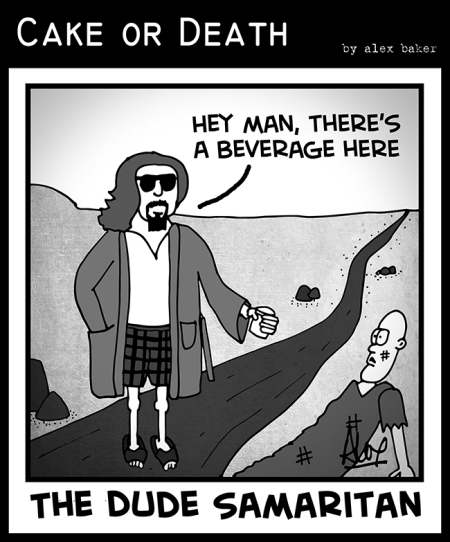
The Dude Samaritan

Cake-or-Death-Christian-Church-Religious-Cartoons-by-Alex-Baker-Good-Samaritan-Big-Lebowski-Jeff-Bridges-The-Dude-Abides-345-(August-17-2015)

From the excellent Cake or Death cartoon blog. I was sad to see that ASBO Jesus wasn't cartooning any more, but I guess once you've produced about 1000 of the things, a break is well deserved.

Tuesday, October 13, 2015

When Should My Parish Church Be Demolished?

There, I trust that picture makes perfect sense.

Alright then... the CofE (not before time) has just launched a major report and review into the use, upkeep and management of its 16000 church buildings. Nearly half the Grade 1 listed buildings in the country are Anglican churches, and many of those are in rural areas, with small populations and even smaller congregations.

The chart above, from the full report, illustrates the big presenting issue. Each vertical line represents a set of the 16000 churches. The line & value in the middle is the average congregation, and the upper and lower lines are the 75th and 25th percentiles. In other words, 25% of CofE congregations are larger than 81, and 25% are smaller than 16.

Outside the CofE, I'm not aware of many groups with a membership of 15 who own their own premises, let alone own premises which are grade 1 listed.

It's even trickier in rural areas. 25% of the congregations there are in single figures, and another 25% are between 10 and 19.

Putting the buildings on the back of a truck and shipping them to where they're needed (new housing estates, replacing urban churches like my own which are now too small for a growing area and congregation) isn't really an option. So far we have muddled through, but the dead stones need to serve the living stones of the church, not stifle them.

If the local church becomes a fundraising body with 'keeping the building open' as its top priority, it is no longer the church Jesus Christ came to establish. Marshall McLuhan observed that we shape our tools, and then our tools shape us. In many places the church (i.e. the people) is being forced out of shape by premises which may be beautiful and soaked in prayer, but are a burden more than they are a blessing. Any local church which couldn't conceive of its existence without a church building would be best served by losing the building anyway. Once masonry (of either sort) defines a church, it's in serious trouble.

There's an open consultation running for several months, and a few ideas already being floated. My fear is that it could turn out much like government planning law: lots of people agreeing in principle that 'something must be done', but hardly anybody wants it done here. At the other extreme, we don't want a Beeching-like cull that destroys all the branch lines.

PS I wonder if there is any causal relationship between a church not being listed, and it having a bigger than average congregation? It would make sense....

update: helpful piece from Ian Paul.
and another from the National Churches Trust.
Richard Chartres lecture on the Diocese of London, reported here a few days ago, talks about creative uses of church buildings in urban settings. The report and consultation is maybe a chance to think more creatively than 'keep them all open at whatever cost' or 'close them all down'.
and quite a bit on the mixed blessing of buildings in this sermon by the ABofC