The 'issue' of Tim Farrons Christian faith has become one of the key debates of the Libdem leadership campaign. We've had party leaders before who've professed some kind of faith, quite a few in fact (Thatcher, Blair, Brown, Cameron) but none as boldly or plainly as Farron.
2 of Norman Lambs team have got into trouble for asking leading questions of Libdem members. They rang to quiz members on what they thought of Farrons views on abortion and gay marriage, whilst asking different questions about Lamb. One Libdem commented:
I was one of those members called and asked about my opinion on Tim Farron. I knew all the background about his faith etc so realised what was going on with the loaded questions etc
It sounds like they were doing this without Norman Lambs authorisation, but the issue hasn't gone away. It was raised at a 5 live phone in this week (from just after 20m in here), and took up a large chunk of the debate. Farron claimed that it was his Christian faith that lay behind the 'push polling' during the debate, and Victoria Derbyshire followed this up by quizzing Farron about his faith, and his views on abortion and sex education. It was good to see Farron standing up for his position on abortion: "I'm not saying it should be illegal, but it is always a tragedy... when anyone is in a situation when they feel that they need one." Farron nailed it "(we should) not be scared off by people who are trying to bracket you". It's interesting that for about 8 minutes of the 30 minute discussion, Norman Lamb doesn't get a word in.
There is an emerging list of liberal 'clobber' issues which are taken as a litmus test for whether anything else you say is worth a hearing. Support for gay marriage is one of them, abortion is another, and I can see euthanasia joining the list before too long. Libdem members are talking openly about feeling excluded:
Current discussions within the party haven’t always been a pleasant experience for me as a Christian. Some in the party seem to have decided that people of faith have no logic, no reason, and shouldn’t hold party positions. I have been told that faith is irrational and that “True Liberals” don’t let faith influence them.
To have this debate out in the open is better than it progressing in whispers behind hands. Hopefully it will create a line in the sand that is clear that committed Christians can play a full part in the LibDems. There shouldn't be a mainstream political party that's closed to people of Christian faith (or any faith, for that matter). And Christian faith is just as valid a reason for holding political views as socialism, neoliberalism, materialism, or any other philosophy.
Thursday, June 25, 2015


Wednesday, June 24, 2015
Fuel for a good life
Some helpful words written as a meditation on Titus 2, about how we become a people 'zealous to do good':
(we go) beyond a Reformation commitment to sola gratia (by grace alone) – it may suggest sola gratitudine (living by gratitude alone), in which a life eager to do good is motivated
- not by pride (you’re better than this)
- threat (you’d better do this)
- or guilt (if only you’d done this)
but simply by unforced, confident, cheerful gratitude.
If your zeal for good works is slipping, don’t look to the law, look to the grace of God in saving you.
(we go) beyond a Reformation commitment to sola gratia (by grace alone) – it may suggest sola gratitudine (living by gratitude alone), in which a life eager to do good is motivated
- not by pride (you’re better than this)
- threat (you’d better do this)
- or guilt (if only you’d done this)
but simply by unforced, confident, cheerful gratitude.
If your zeal for good works is slipping, don’t look to the law, look to the grace of God in saving you.
Tuesday, June 23, 2015
Deliberate deafness: the Conservatives and Food Banks
"Whoever shuts their ears to the cry of the poor will also cry out and not be answered." (Proverbs 21:13)
During the election campaign David Cameron pretended not to know how many people were using food banks in the UK. At least, I hope he was pretending, and actually did know the answer, because any Prime Minister that doesn't know what's happening with the most vulnerable in his society should resign and make way for someone who does.
I'm starting to wonder though. It's almost as if the Conservatives are choosing not to know about food banks. Priti Patel at the DWP claimed in Parliament that 'there is no robust evidence that directly links benefit sanctions and food bank use'. That's apart from the evidence provided by the University of Oxford, the Trussell Trust, Oxfam, the Church of England etc. The evidence is there, so has the government not seen it, or having seen it, are they incapable of accepting it?
The DWP itself has been keeping the Trussell Trust at arms length. Despite government rhetoric about helping the poor through welfare or justice reforms, it seems odd that they wouldn't want to engage with an organisation that sees nearly a million people every year who can't afford to eat. You can almost see David Cameron and Ian Duncan Smith sticking their fingers in their ears and going 'la la la' very loudly whenever food banks are mentioned.
This is all too human. We're well practiced at blocking out inconvenient truths, which don't fit the world the way we've got used to seeing it, or the way we want to see it. The truth sets us free - and in the case of poverty, would set a lot of people free if only the government were minded to see it. But it may also involve admitting that we are wrong. Humility and repentance are costly, but I'd rather have politicians eating their words than thousands of people eating nothing.
During the election campaign David Cameron pretended not to know how many people were using food banks in the UK. At least, I hope he was pretending, and actually did know the answer, because any Prime Minister that doesn't know what's happening with the most vulnerable in his society should resign and make way for someone who does.
I'm starting to wonder though. It's almost as if the Conservatives are choosing not to know about food banks. Priti Patel at the DWP claimed in Parliament that 'there is no robust evidence that directly links benefit sanctions and food bank use'. That's apart from the evidence provided by the University of Oxford, the Trussell Trust, Oxfam, the Church of England etc. The evidence is there, so has the government not seen it, or having seen it, are they incapable of accepting it?
The DWP itself has been keeping the Trussell Trust at arms length. Despite government rhetoric about helping the poor through welfare or justice reforms, it seems odd that they wouldn't want to engage with an organisation that sees nearly a million people every year who can't afford to eat. You can almost see David Cameron and Ian Duncan Smith sticking their fingers in their ears and going 'la la la' very loudly whenever food banks are mentioned.
This is all too human. We're well practiced at blocking out inconvenient truths, which don't fit the world the way we've got used to seeing it, or the way we want to see it. The truth sets us free - and in the case of poverty, would set a lot of people free if only the government were minded to see it. But it may also involve admitting that we are wrong. Humility and repentance are costly, but I'd rather have politicians eating their words than thousands of people eating nothing.
Saturday, June 20, 2015
Amazing Grace
Its simply staggering to read what the families of the victims of the Charleston shootings said in court this week:
Speaking to Dylann Roof in court, she said: "I just want everybody to know, to you, I forgive you. You took something very precious away from me. I will never talk to her ever again. I will never be able to hold her again but I forgive you. And have mercy on your soul. You hurt me, you hurt a lot of people, but God forgive you, and I forgive you.
"Depayne Doctor was my sister. And I too thank you [the judge], on the behalf of my family, for not allowing hate to win. For me, I'm a work in progress, and I acknowledge that I am very angry but one thing Depayne ...taught me [is that] we are the family that love built. We have no room for hate so we have to forgive. I pray God on your soul and I thank God that I won't be around when your judgement day comes with him. May God bless you."
Gun control will take weapons out of peoples hands, and yet again the USA will agonise but do nothing. Only this God-given ability to love, to forgive and show grace will bring and end to violence. These are truly incredible responses - I'm sure my natural reaction would be revenge and anger, but my brothers and sisters in Charleston remind me that Jesus' people can do better than that.
Wednesday, June 17, 2015
Is it because I is black?
Rachel Dolezal is a black American race activist who hit the news recently when it turned out she was white. She resigned from the NAACP earlier this week, but claims a 'self-identification with the black experience...that's how I was portraying myself...on a very real connected level.' The interview on the above link shows someone for whom personal experience trumps reality. Her choice to identify as black equates to being black.
(I'm reminded, oddly, of goal celebrations by mercenary footballers. The more kisses they bestow on the team badge after scoring, they less likely they are to stay at the club next season if a better offer comes along. They self-identify as Chelsea on a very real connected level. For this season.)
We've been here before, but not in a serious way. Ali G turns out to be a prophet, as well as a gangsta. It's an instance of the wider syndrome of personal experience and emotion trumping truth and reality. There is a logic to it - consumer choice (or at least, what we're told is choice) is at the heart of liberal democratic capitalism. Choice has evolved from a virtue to a deity. The prevailing liberal wisdom is that if x is freely chosen by a person, then it is right, whether x is aborting a child, sleeping around, shopping, sexual identity, or when and how to end ones life (preferably on the NHS). The campaign to legalise euthanasia, which the BBC gave another nudge to on Question Time a couple of weeks back, is usually cast in the form of stories, all traumatic and difficult, to make the argument 'who are we to deny people who are suffering so much the choice they most desire?' It's hard to feel sympathy for a generalisation, and equally hard to deny it to an individual. Generalisations deal with principles and argument, individuals deal in choices and personal meaning.
And if we can choose all of these things, rather than have them 'given' by society, culture or religion, then why not race too?
But choice isn't a level playing field. Liberal culture finds it easier to defend the choice of a woman removing clothes for the sexual tittilation of men than a woman who wants to cover herself so as not to be seen as a sex object. Especially if the latter has, God forbid, religious reasons. A recent paper on euthanasia in Belgium notes a change in culture since the law was changed: Social and peer pressure makes it difficult for those who oppose euthanasia to uphold their position in the liberal culture that has been developing.
Our school ran a session on internet safety a few months back. One phrase which stuck with me was 'for children to be children, parents must be parents'. In other words, its a parents responsibility to set boundaries, to keep their children safe, to say 'no' when 'no' needs to be said. Children who grow up having all desires granted become adults who believe that every personal choice is a sovereign act. To be human is to be limited. Testing those limits is part of being human, living as if they don't exist is simply delusional. This is not the Matrix.
and before you say so, I know this isn't a coherent argument, just some thoughts I wanted to have aloud and see what happened to them. If I choose to blog these words but they make no sense, then who are you to tell me I'm wrong? ;-) Where exactly do postmodern people go to adjudicate between competing truths and choices?
(I'm reminded, oddly, of goal celebrations by mercenary footballers. The more kisses they bestow on the team badge after scoring, they less likely they are to stay at the club next season if a better offer comes along. They self-identify as Chelsea on a very real connected level. For this season.)
We've been here before, but not in a serious way. Ali G turns out to be a prophet, as well as a gangsta. It's an instance of the wider syndrome of personal experience and emotion trumping truth and reality. There is a logic to it - consumer choice (or at least, what we're told is choice) is at the heart of liberal democratic capitalism. Choice has evolved from a virtue to a deity. The prevailing liberal wisdom is that if x is freely chosen by a person, then it is right, whether x is aborting a child, sleeping around, shopping, sexual identity, or when and how to end ones life (preferably on the NHS). The campaign to legalise euthanasia, which the BBC gave another nudge to on Question Time a couple of weeks back, is usually cast in the form of stories, all traumatic and difficult, to make the argument 'who are we to deny people who are suffering so much the choice they most desire?' It's hard to feel sympathy for a generalisation, and equally hard to deny it to an individual. Generalisations deal with principles and argument, individuals deal in choices and personal meaning.
And if we can choose all of these things, rather than have them 'given' by society, culture or religion, then why not race too?
But choice isn't a level playing field. Liberal culture finds it easier to defend the choice of a woman removing clothes for the sexual tittilation of men than a woman who wants to cover herself so as not to be seen as a sex object. Especially if the latter has, God forbid, religious reasons. A recent paper on euthanasia in Belgium notes a change in culture since the law was changed: Social and peer pressure makes it difficult for those who oppose euthanasia to uphold their position in the liberal culture that has been developing.
Our school ran a session on internet safety a few months back. One phrase which stuck with me was 'for children to be children, parents must be parents'. In other words, its a parents responsibility to set boundaries, to keep their children safe, to say 'no' when 'no' needs to be said. Children who grow up having all desires granted become adults who believe that every personal choice is a sovereign act. To be human is to be limited. Testing those limits is part of being human, living as if they don't exist is simply delusional. This is not the Matrix.
and before you say so, I know this isn't a coherent argument, just some thoughts I wanted to have aloud and see what happened to them. If I choose to blog these words but they make no sense, then who are you to tell me I'm wrong? ;-) Where exactly do postmodern people go to adjudicate between competing truths and choices?
Thursday, June 11, 2015
Vein Repetition
Sunday is World Blood Donor Day. The NHS needs around 2 1/2 million units of blood a year - if every Christian in the UK gave blood 3 times a year, we'd never run short.
I thought about giving blood for years before finally getting round to it a couple of years ago, and now its a habit. If that's you at the moment, maybe its time to get round to it. Once you start, those nice blood donor people ring you up to remind you to book your next appointment, so its a much easier habit to keep than going to gym.
You get free biscuits, and you may get to save a life. Tithe your platelets!
Tuesday, June 02, 2015
Are you hiding a tightrope-walking dog?
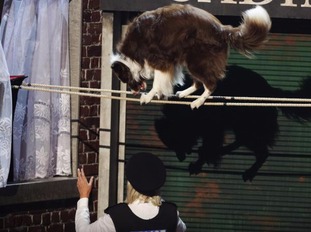
A tightrope-walking dog won Britains Got Talent at the weekend, or did it? It was a remarkable act, but the dog which escaped from jail by tightrope during the routine was actually a stunt double for the star act, Matisse. The second dog was kept hidden backstage throughout the rest of the act, and it was kept hidden both from the judges and the voting public too, who all thought they were voting for a single dog and its trainer.
The routine is very clever, and very skilful, but its in danger of being overshadowed by what was kept hidden backstage.
I mentioned this a few weeks ago, but it keeps cropping up so I'll mention it again. Author Simon Walker talks of our 'frontstage' and 'backstage' - what we allow other people to see, and what we keep out of sight. Alison Morgan has done an excellent summary of his work, and here's a clip:
The two stages can’t be kept completely separate – what goes on in one will always to some extent leak onto the other. This is particularly so for social and spiritual leaders and those in caring professions – their own unmet emotional needs, pushed backstage, generate resentment, envy, pride, anger or even rage – and these things begin to leak frontstage.
When the things we didn't want people to see are discovered, or leak onto the frontstage, the response can be as its been with BGT - quite a lot of upset. There are parts of our lives which, despite the running commentary of social media, are best not disclosed and put on general display. I've actually found that people use Facebook, Twitter and the like more to manage their frontstage - to project an image and the story they want other people to see, it's the brave exceptions who still attract admiring comments.
But it's best not to have secrets if we can possibly avoid it. There is a merciful Judge who knows exactly what is going on backstage, as well as front, and, to our surprise, won't vote us off if we own up.
Monday, June 01, 2015
WATCH with Mother: recreating God in our own image?
“If we take seriously the idea that men and women are made in the image of God both male and female language should be used.”
When I meet someone new, I introduce myself as David. I'm gently riled if they then refer to me as 'Dave'. Dave is a TV channel, my name is David. That's how I've chosen to identify myself.
WATCH (Women And The Church) have for some time now advocated using female terms to refer to God. The Bible has female imagery (Jesus speaks of himself as a mother hen, for example), and the danger of using one set of words repeatedly is that they can come to confine God to a certain set of meanings, rather than allow God to be God. The issue has surfaced again over the weekend.
Under all of this is the basic question: has God revealed Him/Her/Its self to us. Has God given us a name by which to call him? (I'm going to use the male pronoun out of habit and precedent, and because it'll be unreadable otherwise). Through scripture, and Jesus (God incarnate, lets remember), has God given us particular ways in which to understand his character and nature? If so, then these images, metaphors and words have to anchor our ways of talking about God. Alternatively, if these are just the best guess of the people at the time, then we're quite within our rights to talk about God in any way we like. We are more likely to end up making God in our image, but at least we can ditch the words we find unhelpful or upsetting.
Cranmer has a piece up at the moment on 'truthiness' - our tendency to believe the things we want to be true, rather than the things that actually are true. History is littered with attempts to rewrite the Christian faith in the image of the writer, or the culture of the time, to have the God that we want to be real, rather than God as he actually is. If God is fundamentally other, then in describing him in the metaphors and titles we prefer there is the danger that we simply end up talking about humanity in a very loud voice, and cease to talk about the God who is who God is.
In WATCH's terms, this is part of a long-term goal to change the language we use about God: Watch’s chairwoman, Hilary Cotton, added: “We are at a very, very preliminary stage in terms of shifting the language of worship.
“The question of how might we rewrite the worship services of the Church of England in a way that broadens our understanding and perception of God is a really difficult question over which we will wrestle for a number of years to come.
Yes we need to use the full range of Biblical language to talk about God: wind and fire, judge and servant, warrior and lover, etc. But it's a brave person who thinks they know God better than Jesus: 'when you pray, say 'Father....' Of course, I'm a bloke, so this can all be discounted as patriarchal ranting by a theological dinosaur. But once we end up with a definition and an image of God that we're entirely comfortable with, then we're in trouble. We're sinners, we aren't whole people, we will only be entirely comfortable with God when we're fully renewed with him in glory. A God who really is God will never be an easy God for anyone in this life, as a skim-read of the Psalms will testify.
Yes, lets broaden our understanding and perception of God, but lets make sure it's God we're looking at, not just a reflection of ourselves.
The story is told of a girl who was hard at work drawing a picture. The teacher asked what she was doing: "I'm drawing a picture of God" she answered. "But nobody knows what God looks like." responded the teacher. She replied "they will when I've finished."
update: if you can bear it, here's a list of links to various comments and opinion blogs on this topic, which for some reason doesn't include Ian Pauls piece.
When I meet someone new, I introduce myself as David. I'm gently riled if they then refer to me as 'Dave'. Dave is a TV channel, my name is David. That's how I've chosen to identify myself.
WATCH (Women And The Church) have for some time now advocated using female terms to refer to God. The Bible has female imagery (Jesus speaks of himself as a mother hen, for example), and the danger of using one set of words repeatedly is that they can come to confine God to a certain set of meanings, rather than allow God to be God. The issue has surfaced again over the weekend.
Under all of this is the basic question: has God revealed Him/Her/Its self to us. Has God given us a name by which to call him? (I'm going to use the male pronoun out of habit and precedent, and because it'll be unreadable otherwise). Through scripture, and Jesus (God incarnate, lets remember), has God given us particular ways in which to understand his character and nature? If so, then these images, metaphors and words have to anchor our ways of talking about God. Alternatively, if these are just the best guess of the people at the time, then we're quite within our rights to talk about God in any way we like. We are more likely to end up making God in our image, but at least we can ditch the words we find unhelpful or upsetting.
Cranmer has a piece up at the moment on 'truthiness' - our tendency to believe the things we want to be true, rather than the things that actually are true. History is littered with attempts to rewrite the Christian faith in the image of the writer, or the culture of the time, to have the God that we want to be real, rather than God as he actually is. If God is fundamentally other, then in describing him in the metaphors and titles we prefer there is the danger that we simply end up talking about humanity in a very loud voice, and cease to talk about the God who is who God is.
In WATCH's terms, this is part of a long-term goal to change the language we use about God: Watch’s chairwoman, Hilary Cotton, added: “We are at a very, very preliminary stage in terms of shifting the language of worship.
“The question of how might we rewrite the worship services of the Church of England in a way that broadens our understanding and perception of God is a really difficult question over which we will wrestle for a number of years to come.
Yes we need to use the full range of Biblical language to talk about God: wind and fire, judge and servant, warrior and lover, etc. But it's a brave person who thinks they know God better than Jesus: 'when you pray, say 'Father....' Of course, I'm a bloke, so this can all be discounted as patriarchal ranting by a theological dinosaur. But once we end up with a definition and an image of God that we're entirely comfortable with, then we're in trouble. We're sinners, we aren't whole people, we will only be entirely comfortable with God when we're fully renewed with him in glory. A God who really is God will never be an easy God for anyone in this life, as a skim-read of the Psalms will testify.
Yes, lets broaden our understanding and perception of God, but lets make sure it's God we're looking at, not just a reflection of ourselves.
The story is told of a girl who was hard at work drawing a picture. The teacher asked what she was doing: "I'm drawing a picture of God" she answered. "But nobody knows what God looks like." responded the teacher. She replied "they will when I've finished."
update: if you can bear it, here's a list of links to various comments and opinion blogs on this topic, which for some reason doesn't include Ian Pauls piece.
Subscribe to:
Posts (Atom)