Monday, June 09, 2014

Islam: Presentation or Content?

With the 'Trojan Horse' reports due out today (update: now published, very serious stuff), Charles Moore puts his finger on something that's been bothering me for a while now:

The question for the rest of us lies in the issue itself. How big is the problem with Islamist extremism, and why is dealing with it so contentious that it splits all the parties?
Stand back and think of some news stories in the past fortnight or so. The search for the 300 Nigerian girls kidnapped by Boko Haram; the Sudanese government’s death sentence for apostasy on a pregnant mother; murders in the Jewish Museum in Brussels; the exchange of Taliban prisoners for their dubious American captive soldier Bo Bergdahl; alleged election-rigging in Tower Hamlets; the revelation that some jihadists in Syria are British citizens; and finally, the row about the Birmingham schools.
All these stories are about a religion in ferment. I do not agree with the growing numbers in the West who see Islam itself as inherently violent. All great religions contain so much of the human story that nasty bits can always be extracted by nasty people. (There was a time, remember, when many Christian adherents were more bloodthirsty than the Muslims, let alone the Jews, whom they persecuted.) What is happening, rather, is that the “ownership” of Islam is in contention.
The loudest voices in this struggle, unfortunately, are of those who turn their faith against the free, Western world. In their story, an amazing Muslim civilisation has been trashed by Christians, Jews, white men in general. No blame for misgovernment and economic failure attaches to Muslim countries themselves, except to those leaders (“hypocrites”) who sell out to the West.
You can add to Moores list the stoning to death of a pregnant woman in Pakistan, and the longer-term reality for Christians in just about any country you care to name with a Muslim majority. For example, when Saudi Arabia makes it illegal to convert from Islam to Christianity, and brutally treats anyone who helps people to do this, is that an aberration from what Islam is really about, or standard practice? 
Maybe it is simply that the concentration of power, whether in a state, a London borough, or a school network, warps the hearts and minds of those who have it, as historically it has also done with the church. Even so, Islam still has a problem, because it is set up (via Sharia law etc.) as a system of government as well as a spiritual path. Jesus consciously resisted political power, or anyone seeking to set it up (e.g. Acts 1), insisting that God's kingdom was of a different nature. Christianity doesn't have a system of state government and law built into it in the way that Islam does. 
Maybe, along with the BBC, I'm just hoovering up a narrative that only bears a partial relationship to the truth. And asking questions of Islam will mean asking questions of the church too. But here's my question: are the headlines of the last few weeks mainly a presentation problem - that there are just as many good news stories but they aren't told because they don't fit the media narrative, and don't, in Charles Moore's words, involve the loudest voices? Or does this sorry catalogue actually express something more closely at the heart of  'true Islam'? If there is another side of the story, I'd like to hear it. 
(and why do I feel so wary in blogging these questions?)

Wednesday, June 04, 2014

Call to Prayer from Justin Welby


Prayer has to be our first priority, if we are to call more people to follow Christ, and to invite others to share in the story of God’s love for the world. The wonderful news is God is always ready to hear our prayers and to send his Spirit that we may proclaim the good news afresh. I urge every church community and individual to set aside time to pray and to share God’s heart for all his people.”

Having an Archbishop of Canterbury prepared to say that the main business of the church is calling people to follow Jesus, and calling us to pray together for that, takes some getting used to. But I'm quite happy to get used to it. This call to prayer is on the new Use Words website, one of the first fruits of the Archbishops new evangelism task group. I love the title: there is a lot of talk about the supposed line from St. Francis 'preach the gospel, use words if necessary'. The spurious attribution to Francis (there is no record of him ever having said it) gives it credibility, the idea that words are an optional part of the gospel ('good news') is simply bizarre. It's a great escape hatch for British Christians who are shy about evangelism, and it needs to be challenged. 

The other great thing is that a site devoted to evangelism in the CofE starts by being devoted pretty much entirely to prayer. Spot on. The Pentecost story (which the CofE is living through at the moment in the church year), sketches out the pattern: spend time with Jesus, wait, pray, then into Spirit-led mission. The 'great commission' is given with the instruction to wait prayerfully first. 

Justin Welby has also written this tie-in piece 'what we talk about when we talk about evangelism', for Christan Today

update: excellent piece by Chris Russell in the Church Times. 

The Invention of Cricket - new evidence


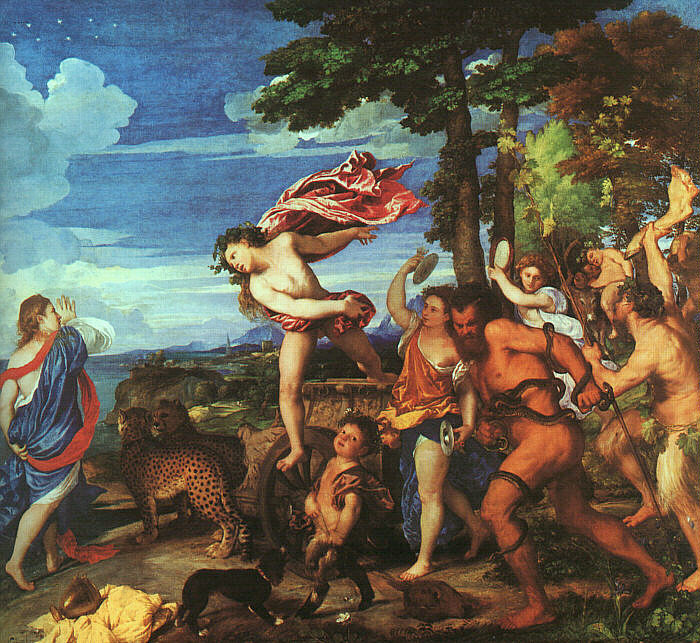
I'm not a great expert on ancient art, but saw this one in a newspaper the other day and was struck, as any cricketer would be, by the central figure. It's Titians 'Bacchus and Ariadne', but chap in the middle is clearly a right-handed Ryan Sidebottom. The ball and batsman are out of shot but the umpire (on the left, facing the wrong way) is already signalling 4. This may be a sign of early match fixing, especially as the figure behind the bowler seems to be waving a bag of money at the umpire. Or she might be an IPL cheerleader with a wardrobe malfunction.

The crowd, as is normal at cricket matches, are a mixed bag - some are watching the play, some are asleep, one is struggling with the flex on their radio headphones (at least, I assume that's what the guy with the beard is doing). It's clearly a hot day, late afternoon, as shown by the absence of clothes, and the figure entering the picture on the right is just about to streak across the pitch, reviving one of the ancient and noble traditions of cricket.

With the umpire wearing blue and the player red, it's probably a one day match, and the floodlights are just coming on (top left). Though what those animals are doing on the pitch is anybody's guess.

I suspect that the original name of the picture was 'Batters and Arnie', having mistaken Ryan Sidebottom for his father.

Tuesday, June 03, 2014

Job Description for a Bishop

Our new Bishop of Bath and Wells is being installed this weekend (makes him sound like a piece of software). Here is the opening section of his job description, or 'Archbishops Charge' to give it the proper title:

Recalling God’s mission entrusted by Christ to His Church to proclaim God’s Kingdom, to  heal the sick and to make disciples of all nations, I now set before you the key tasks identified for you by the Crown Nominations Commission, to guide you as you prepare to take up your new office and ministry 

 To share the gospel across the diocese of Bath and Wells and to nurture the confidence of others to do likewise; to foster spiritual and numerical growth in parishes, benefices and communities encouraging aspirations for a growing and flourishing Church. 

That'll do for starters. See the rest here. It would be great if this (or a version of it) could be the opening paragraph of every clergy job description in the Diocese too. After all, it's only 69 years since the CofE recommended this change, I think that's long enough to wait.

Peter Hancock, the new bishop, has even recorded a Pentecost sermon for showing in local churches this Sunday:


"each and every day I need to ask God the Holy Spirit to stir me up, in order that my life might reflect faithfully the love of Christ"

"Send your Holy Spirit upon us
and clothe us with power from on high"
Amen

Sunday, June 01, 2014

UJIP

Lets see:

 - Freedom to run your own country without interference from a big European power
 - Independent nationhood
 - A return to the good old days
 - Keep our country for the people it belongs to and kick out the foreigners who are spoiling it.

Yes, it's the United Judean Independence Party.....

"So when they met together , they asked him, "Lord, are you at this time going to restore the kingdom to Israel?" (Acts 1:6)

All together for the next hymn, 'Jerusalem'......

Wednesday, May 28, 2014

Can Mammon Be Moral?

Bankers should see their job as a vocation and adopt higher ethical standards, the governor of the Bank of England has said. 

More on Mark Carney's thoughts here, in a BBC report on the 'Conference on Inclusive Capitalism'. The conference, pulling together people who own 1/3 of the worlds investable assets between them (the brain-watering sum of £30 trillion). The 'inclusive' bit seems to be how to share the wealth generated by capitalism with more people. It recognises that capitalism has an image problem, so I'm not sure whether the agenda of a more robust ethic is simple self-preservation, or a genuine concern to do what's right, because it's right, not just because it's of benefit.

Christine Lagarde of the IMF at the same conference: said the changes required both investors and the leaders of financial firms to "take values as seriously as valuations" and "culture as seriously as capital". "Ultimately, we need to ingrain a greater social consciousness - one that will seep into the financial world and forever change the way it does business," 

That would be nice, but it's not going to happen within the current system: how do you award bonuses for moral behaviour? And if you wanted people who valued morals as highly as money, then you wouldn't be employing people whose prime motivation was to get a bonus anyway. The bonus system gives the City leverage over its employees, for Lagardes words to come true, the bosses would need to abandon the power the bonus system gives them, and the workforce would need to become motivated by something entirely different. Capitalism is about making money. It spits out social consciousness like a bad taste. Unless you hard wire fair trade, living wage, etc. into the system through legislation and as a precondition of doing business, the system will carry on as it is. The UK governments failed attempts to persuade banks to lend more to small business as a precondition of state support is one small (by global standards) example of how difficult this is. Nudge theory is not going to work, moral responsibility simply will not 'seep into the financial world'.

Meanwhile in the world of mere mortals, Justin Welby is taking the first steps on deliving on his promise to compete Wonga out of business. With 7m people using high cost credit providers, the CofE is piloting a 'Credit Champions Network' in 3 dioceses. More details here, Looks like it will be an evolving thing, a huge challenge to take on, but exactly the sort of thing the church should be involved in. 

Wednesday, May 21, 2014

Make Lunch

Such a simple, but brilliant idea

13 weeks a year when 3.5 million children who get free school meals, don't get free meals. 1000s of churches with kitchens and volunteers. Make Lunch.

For anyone wondering how to get started, the Cinnamon Network give micro grants of up to £1k to pump prime community projects like this one.

And if you're not sure about catering quantities, you're in good company, Jesus was rubbish at it. Put him in charge of the kitchen, and there's a trail of leftovers - Cana, feeding of the 5000, Emmaus,....

Tuesday, May 20, 2014

Why Vote?


I'll be voting on Thursday in the Euro elections, and I'm about 80% decided who I'll be voting for. I think I'd argue that Christians have a responsibility to vote, that passive abstention is not an option. If we believe God loves this world and wants to bless, heal and remake it, then we have no business opting out of the way it's governed. 

It wouldn't take much to get me arguing that everyone should vote, but then someone will start complaining that that's judgmental and coercive and everyone should be free to make their own decisions (because remember there is no such thing as society, citizenship, duty and so on, just individual free choice) etc. etc. So I'll leave that one for now.

Having said all that, it's not a great choice this year:
 - A party which wants to cut foreign aid and green policies (though see this)
 - A party which says the EU is great but claims in its election leaflet that we have to 'fight' for favours from it. If it is that great, what's with the fighting talk?
 - A party which hasn't said a thing about Europe during the election campaign, and has focused it's main guns on belittling politicians from other parties (literally) and the NHS. Last time I looked, the NHS wasn't run from Brussels, or by local councils, the General Election is next year Ed.
 - A party which has been in government for 4 years, and kicks the can down the road for a further 3
 - A party whose leaflet consisted entirely of policies applicable to the EU, and contained no personal attacks whatsoever. 

Hmm. But if the choices aren't great then I know what to do. And it's not to abstain and walk away.

(thanks to Dave Walker for the brilliant cartoon)

For something more in depth, try this from Ian Paul.